
The Mathematical Logic Behind Geometric Proofs: Exploring Implication with Inter
Loading the math board and drawing, please wait…
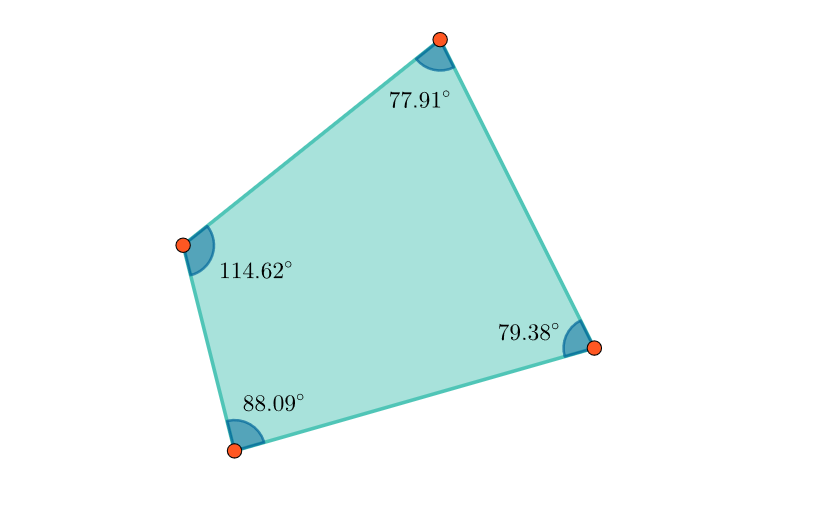
This GeoGebra example demonstrates how logical implication works in geometric proofs by dynamically exploring the interior angles of a polygon. It constructs a polygon (poly1) with vertices A, B, C, D and uses the InteriorAngles command to generate angles α, β, γ, δ. The Sequence and Sort commands are then applied to order these angles, revealing patterns and logical dependencies. The core mathematical concepts include conditional reasoning, implication in geometry, the polygon interior angle sum theorem, and the structure of rigorous proof. The construction highlights how GeoGebra commands like Polygon, InteriorAngles, Sequence, and Sort can be used to scaffold step-by-step reasoning. This resource is ideal for middle and high school geometry classes, helping students understand why each step in a proof is valid and how to build logical chains from assumptions to conclusions, thereby strengthening both geometric intuition and formal reasoning skills.
GeoGebra Commands & Parameters
Sort(Sequence[(arg(Element[original, i] - ZZ), i), i, 1, Length[original]]) → original_hSequence(Element[original, y(Element[original_h, i])], i, 1, Length[original]) → original_sPolygon(original_s) → poly1InteriorAngles(poly1) → α, β, γ, δ
AI Drawing Prompt Reference
Draw a polygon with four vertices labeled A, B, C, D. Show the interior angles α, β, γ, δ and arrange them in order. Highlight the logical relationships between angles to help understand conditional reasoning and the interior angle sum theorem in geometric proofs.
The prompt above was compiled from the original drawing commands and is for reference only.