
Pentagram Flower Construction
Loading the math board and drawing, please wait…
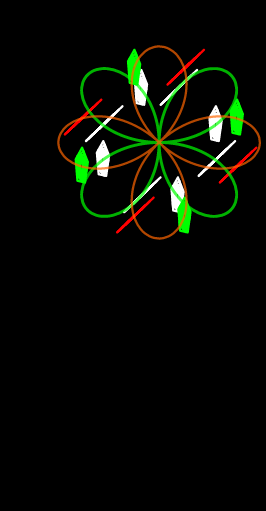
This example demonstrates how to construct a pentagram flower pattern using parametric curves and sequences. It involves core mathematical concepts like angles, geometric constructions, transformations, parametric equations, and sequences. Key GeoGebra commands and objects used include PolyLine, Point, Length, Sequence, and CurveCartesian. Suitable for high school mathematics teaching to understand parametric curves, symmetry, and geometric transformations.
GeoGebra Commands & Parameters
PolyLine(Sequence[Point[sin(π / n + ((2 * π / n) * i) - {0, π / 2})], i, 0, n]) → fPoint(f, t) → ALength(A) → rSequence(PolyLine[Sequence[Point[((((sin((((2 * 2) * π) * t)) * sin(((2 * π) * t) - {0, π / 2})) * R) * r^(j)) * sin(((-π)) / n - ((sin((((2 * 2) * π) * t)) * 2) * π) - (δ * j) - ((2 * π / n) * i) - {0, π / 2}))], i, 0, n]], j, 0, depth - 1) → l1Sequence(PolyLine[Sequence[Point[((((sin((((2 * 2) * π) * t)) * sin(((2 * π) * t) - {0, π / 2})) * R) * r^(j)) * sin(π / n + ((sin((((2 * 2) * π) * t)) * 2) * π) + (δ * j) + ((2 * π / n) * i) - {0, π / 2}))], i, 0, n]], j, 0, depth - 1) → l2CurveCartesian((sin((2 * θ)); θ), θ, 0, (2 * 3.141592653589793)) → aSequence(Translate[l1, (y(ί^(((2 * 4) * (t + (1 / N * j))))) * ί^((4 * (t + (1 / N * j)))))], j, 1, N) → l1'Sequence(Translate[l2, (y(ί^(((2 * 4) * (1 - (t + (1 / N * j)))))) * ί^((4 * (1 - (t + (1 / N * j))))))], j, 1, N) → l2'CurveCartesian((cos((2 * θ)); θ), θ, 0, (2 * 3.141592653589793)) → bSequence(Translate[l1, (x(ί^(((2 * 4) * (t + (1 / N * j))))) * ί^((4 * (t + (1 / N * j)))))], j, 1, N) → l3Sequence(Translate[l2, (x(ί^(((2 * 4) * (1 - (t + (1 / N * j)))))) * ί^((4 * (1 - (t + (1 / N * j))))))], j, 1, N) → l4
AI Drawing Prompt Reference
Draw a pentagram flower pattern. Start by creating a pentagram shape. Then use parametric curves and sequences to generate a curve. Connect these curves using sequences to form petal-like structures. Finally, apply symmetry transformations and rotations to complete the pattern. Ensure the pattern maintains symmetry and geometric beauty.
The prompt above was compiled from the original drawing commands and is for reference only.