
Sum of Interior Angles of Any Polygon: Explore & Verify
Loading the math board and drawing, please wait…
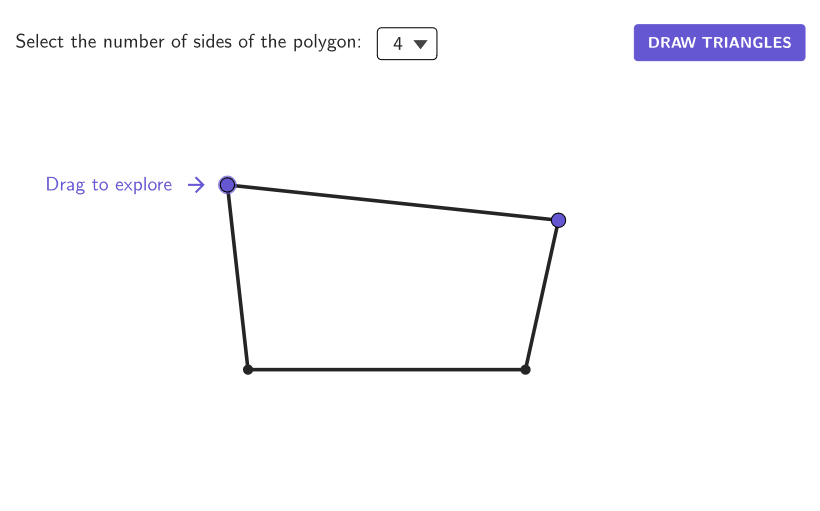
This GeoGebra example demonstrates how the sum of interior angles changes as a polygon’s number of sides increases, and it supports guided reasoning by having students predict the answers for a triangle, a 10-gon, and a 100-gon. Key concepts include polygon interior angles, the interior-angle-sum relationship, dividing a polygon into triangles as a reasoning strategy, and measuring/aggregating angles to verify the pattern. Construction highlights: Polygon builds the polygon from vertices; Point, Segment, and Angle compute each interior angle; geometric transformations such as Rotate, Dilate, and Mirror help position or replicate components needed for the construction workflow; Intersect plus Circle/CircleSector provide auxiliary construction geometry (e.g., reference points or angle regions); Midpoint and If support automation for selecting/organizing objects. The angles are collected (e.g., allAng4/5/6) and displayed with question/result text (textQuestion, textAllIn). Suitable for Grades 6–8 as a classroom activity, investigation, or verification of the interior-angle-sum rule.
GeoGebra Commands & Parameters
Mirror(P1, yAxis) → P1'Mirror(P1', xAxis) → P1''Mirror(P1'', yAxis) → P1'''Polygon(P1, P1', P1'', P1''') → peep, p1, p1', p1'', p1'''SelectedIndex(ddMenu) → isMirror(A, x = x(CEN)) → BIntersect(xAxis, yAxis) → OCircle(CEN, A) → cPoint(c) → CPoint(c) → DPoint(c) → EPoint(c) → FPolygon(If[is ≟ 1, {A, B, C, D}, is ≟ 2, {A, B, C, D, E}, {A, B, C, D, E, F}]) → poliDilate(B, If[0 < aniSli ≤ 1, 1 - aniSli, 0], D) → B'Segment(B, B') → segmBDAngle(A, B, D) → allAng4Angle(D, A, B) → allAng5Angle(B, D, A) → allAng6Angle(D, B, C) → allAng1Angle(C, D, B) → allAng2Angle(B, C, D) → allAng3Dilate(A, If[0 < aniSli ≤ 1, 1 - aniSli, 0], D) → A'Segment(A, A') → segmADAngle(E, A, D) → fiveAng1Angle(D, E, A) → fiveAng2Angle(A, D, E) → fiveAng3Dilate(F, If[0 < aniSli ≤ 1, 1 - aniSli, 0], D) → F'Segment(F, F') → segmFDAngle(F, A, D) → sixAng1Angle(D, F, A) → sixAng2Angle(A, D, F) → sixAng3Angle(E, F, D) → sixAng4Angle(D, E, F) → sixAng5Angle(F, D, E) → sixAng6Segment(G, H) → angBase3Segment(K, L) → angBase2Midpoint(I, J) → M1Midpoint(K, L) → M2Midpoint(G, H) → M3Segment(I, J) → angBase1Rotate(J, allAng1, M1) → J1Rotate(J1, allAng2, M1) → J2CircleSector(M1, J, J1) → allAng1RecapCircleSector(M1, J1, J2) → allAng2RecapCircleSector(M1, J2, I) → allAng3RecapRotate(L, allAng4, M2) → L1Rotate(L1, allAng5, M2) → L2CircleSector(M2, L, L1) → allAng4RecapCircleSector(M2, L1, L2) → allAng5RecapCircleSector(M2, L2, K) → allAng6RecapRotate(H, fiveAng1, M3) → H1Rotate(H1, fiveAng2, M3) → H2CircleSector(M3, H, H1) → fiveAng1RecapCircleSector(M3, H1, H2) → fiveAng2RecapCircleSector(M3, H2, G) → fiveAng3RecapIf(is ≟ 2, H + (3, 0), L + (3, 0)) → MMidpoint(M, N) → M4Segment(M, N) → angBase4Rotate(N, sixAng1, M4) → N1Rotate(N1, sixAng2, M4) → N2CircleSector(M4, N, N1) → sixAng1RecapCircleSector(M4, N1, N2) → sixAng2RecapCircleSector(M4, N2, M) → sixAng3RecapSegment(P, Q) → angBase5Midpoint(P, Q) → M5Rotate(Q, sixAng4, M5) → Q1Rotate(Q1, sixAng5, M5) → Q2CircleSector(M5, Q, Q1) → sixAng4RecapCircleSector(M5, Q1, Q2) → sixAng5RecapCircleSector(M5, Q2, P) → sixAng6RecapSegment(M1, J1 + (0.5 * UnitVector[Segment[M1, J1]])) → div11Segment(M1, J2 + (0.5 * UnitVector[Segment[M1, J2]])) → div12Segment(M2, L1 + (0.5 * UnitVector[Segment[M2, L1]])) → div21Segment(M2, L2 + (0.5 * UnitVector[Segment[M2, L2]])) → div22Segment(M3, H1 + (0.5 * UnitVector[Segment[M3, H1]])) → div31Segment(M3, H2 + (0.5 * UnitVector[Segment[M3, H2]])) → div32Segment(M4, N1 + (0.5 * UnitVector[Segment[M4, N1]])) → div41Segment(M4, N2 + (0.5 * UnitVector[Segment[M4, N2]])) → div42Segment(M5, Q1 + (0.5 * UnitVector[Segment[M5, Q1]])) → div51Segment(M5, Q2 + (0.5 * UnitVector[Segment[M5, Q2]])) → div52circlePixels(C, 7 + (7 * pulsing), Corner[1], Corner[3], Corner[5]) → pulsingObject
AI Drawing Prompt Reference
Draw a diagram to verify the sum of interior angles of a polygon. Start with a square as reference, then a circle with several points on it. Based on a dropdown selection, construct a polygon with three, four, or five vertices from these points. Connect one vertex to others to divide the polygon into triangles, and label each interior angle. Use circular arcs to represent each angle measure, and display the total sum. Include an animation slider that controls auxiliary segments from a vertex to opposite sides, illustrating how the polygon is triangulated to derive the angle sum.
The prompt above was compiled from the original drawing commands and is for reference only.