
The Exponential Function as an Isomorphism
Loading the math board and drawing, please wait…
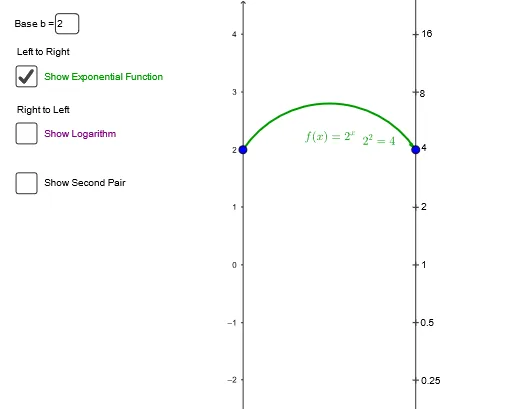
This example demonstrates how exponential functions and their inverses preserve structural properties, showcasing the concept of isomorphism. Key math concepts include exponential functions, logarithms, function inverses, and vector operations. GeoGebra commands like Point, CircleArc, Tangent, Rotate, Textfield, Vector, Midpoint, Mirror, and Segment are used to construct the visual representation. Suitable for high school and advanced learners exploring function properties and geometric transformations.
GeoGebra Commands & Parameters
Point(a) → BPoint(yAxis) → ACircleArc(C, B, A) → cTangent(B, c) → d,Point(d) → ERotate(E, 8°, B) → E'Textfield(b) → inputBox1Vector(F, B) → uMidpoint(A, B) → GMirror(c, G) → c'Mirror(F, G) → F'Vector(F', A) → wPoint(yAxis) → HPoint(a) → ICircleArc(J, I, H) → kCircleArc(K, H, I) → pVector(L, I) → iVector(M, H) → jSegment(U, T) → mSegment(W, V) → nMidpoint(m) → RMidpoint(n) → SCircleArc(Z, O, N) → sCircleArc(A_1, N, O) → c_1Vector(R, N) → u_1Vector(S, O) → rMidpoint(A, T) → B_1Midpoint(B, V) → C_1Midpoint(I, W) → D_1Midpoint(H, U) → E_1Segment(B_1, T) → qSegment(C_1, V) → f_1Segment(D_1, W) → g_1Segment(E_1, U) → h_1Midpoint(H, K) → F_1Midpoint(Z, O) → G_1