
Second Proof of Pythagorean Theorem by Shear Transformation
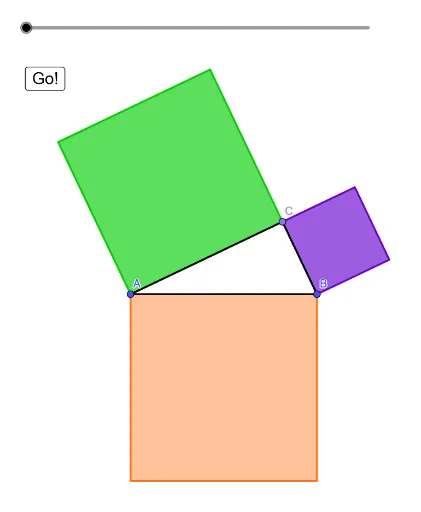
Loading the math board and drawing, please wait…
This GeoGebra example demonstrates a second geometric proof of the Pythagorean theorem using shear transformations. The core mathematical concepts include the Pythagorean theorem, area preservation under shear, and congruence of shapes. The construction employs GeoGebra commands such as Polygon to build the right triangle and squares on its sides, OrthogonalLine and Line to create auxiliary lines, Intersect to locate key points, Vector to apply shear transformations, and Rotate/Angle to visualize angle relationships. By shearing the squares on the legs into parallelograms and then into the square on the hypotenuse, the proof shows area equality dynamically. This resource is ideal for middle and high school geometry classes, as well as introductory college mathematics, offering an intuitive visual approach to a classic theorem.
GeoGebra Commands & Parameters
Max(0, Min[A1 - 1, 0.8] / 0.8) → A7Semicircle(A, B) → cPoint(c) → CPolygon(A, C, 4) → poly1, f, g, h, i, D, EPolygon(C, B, 4) → poly2, j, k, l, m, F, GPolygon(B, A, 4) → poly3, n, p, q, r, H, IOrthogonalLine(C, n) → sLine(E, D) → tIntersect(s, t) → JVector(D, J) → uVector(G, J) → vMax(0, Min[A1 - 2, 0.8] / 0.8) → A2Max(0, Min[A1 - 3, 0.8] / 0.8) → A3Max(0, Min[A1 - 4, 0.8] / 0.8) → A4Intersect(s, q) → KCircle(C, ((A2 * (1 - A2)) * Min[f, j] / 2)) → B2Segment(B3, C3) → D3Intersect(n, D3) → E3Angle(A, E3, C) → F3Polygon(A, C, B4, C4) → D4, E4, F4, G4, H4Max(0, Min[A1 - 5, 0.8] / 0.8) → A5Polygon(B, C5, B5, C) → D5, E5, F5, G5, H5Line(D, E) → I4Polygon(A, B, C) → t1, c_1, a_1, bMax(0, Min[A1, 0.8] / 0.8) → A6Rotate(B, (90° * A6), A) → B6Rotate(C, (90° * A6), A) → C6Polygon(A, B6, C6) → D6, E6, F6, G6Rotate(C, ((-(90°)) * A7), B) → C7Rotate(A, ((-(90°)) * A7), B) → B7Polygon(B, B7, C7) → D7, E7, F7, G7Line(C5, B5) → I5Intersect(n, s) → LVector(C, L) → wMax(0, Min[A1 - 6, 0.8] / 0.8) → A8Polygon(A, B8, C8, C4) → D8, E8, F8, G8, H8Polygon(B, B8, C8, C5) → I8, J8, K8, L8, M8Max(0, Min[A1 - 7, 0.8] / 0.8) → A9Rotate(A, (90° * A9), M) → B9Rotate(B, (90° * A9), M) → C9Rotate(C, (90° * A9), M) → D9Polygon(B9, C9, D9) → E9, F9, G9, H9Max(0, Min[A1 - 8, 0.8] / 0.8) → A10Vector(A, H) → dPolygon(B10, C10, D10) → J10, K10, L10, M10Polygon(C10, D10, E10, F10) → N10, O10, P10, Q10, R10Polygon(E10, F10, G10, H10) → S10, T10, U10, V10, W10