
The Dice Are Cast: Random Cube and Geometric Probability
Loading the math board and drawing, please wait…
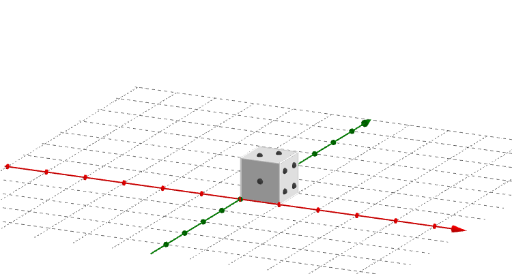
This GeoGebra example demonstrates a randomly generated cube, visualizing the structure of a solid with its faces and edges while incorporating randomness to introduce probabilistic and set-theoretic ideas. The core mathematical concepts include solid geometry (six faces and twelve edges of a cube), stochastic processes (using the Random command to generate random parameters), set theory (partitioning faces into sets), and inequalities (possibly constraining random ranges). Construction details: the Line command draws edges, Cube constructs the cube, Random generates random values, and Element selects items from lists; objects include vertices A-H, faces like FlächeABCD, edges like KanteAB, and buttons (Schaltfläche) to trigger random updates. Suitable for upper secondary or early university students, this interactive tool helps explore the intersection of geometry and probability, and can serve as a dynamic classroom demonstration of randomness in geometric constructions.
GeoGebra Commands & Parameters
Line((r, 0, 0), (r, 1, 0)) → grLine((l, 0, 0), (l, 1, 0)) → glLine((0, o, 0), (1, o, 0)) → goLine((0, u, 0), (1, u, 0)) → guCube(A, B, C) → a, D, FlächeCDHG, FlächeEFGH, KanteAD, KanteAB, KanteBC, KanteCD, KanteAE, KanteDH, KanteEH, KanteEF, E, KanteBF, KanteFG, KanteCG, KanteGH, F, G, H, FlächeABCD, FlächeADHE, FlächeABFE, FlächeBCGFRandom(1, Length[LB]) → kElement(LB, k) → Bild10