
Spider and Fly
Loading the math board and drawing, please wait…
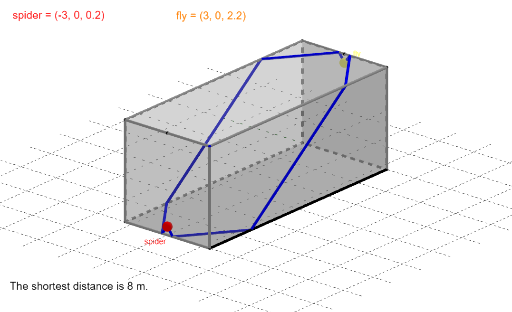
This example demonstrates the shortest path problem between a spider and a fly. Key mathematical concepts include similar triangles, angles, and optimization. Using GeoGebra commands such as Mirror, Polygon, PointIn, etc., complex geometric shapes can be constructed. Suitable for high school mathematics education and learning.
GeoGebra Commands & Parameters
Mirror(A, xAxis) → DMirror(A, (0, 0, 0)) → CMirror(A, yAxis) → BPolygon(A, B, C, D) → v1, a, b, c, dPrism(v1, E) → quad, F, KanteBF, KanteCG, KanteDH, KanteEF, KanteFG, KanteGH, KanteEH, G, H, FlächeABFE, FlächeBCGF, FlächeCDHG, FlächeADHE, Deck, KanteAENet(quad, l_{13}) → net1, I, R, S, T, U, V, Fläche7, Fläche8, Fläche9, Fläche10, Fläche11, J, Fläche12, Kante19, Kante20, Kante21, Kante22, Kante23, Kante24, Kante25, Kante26, Kante27, K, Kante28, Kante29, Kante30, Kante31, Kante32, Kante33, Kante34, Kante35, Kante36, Kante37, L, M, N, O, P, QPointIn(FlächeADHE) → spiderPointIn(FlächeBCGF) → flyDistance(A, B) → langRotate(spider_B, 90°, A) → spider2Rotate(spider2, 90°, M) → spider3Rotate(spider_B, -90°, D) → spider1Segment(spider3, fly_B) → l_{10}Segment(spider2, fly_B) → l_8Segment(spider1, fly_B) → l_2Segment(spider_B, fly_B) → l_5Rotate(fly_B, -90°, B) → fly2Rotate(fly2, -90°, N) → fly3Segment(spider_B, fly3) → l_{11}Segment(spider2, fly2) → l_9Segment(spider1, fly2) → l_3Segment(spider_B, fly2) → l_6Rotate(fly_B, 90°, C) → fly1Segment(spider2, fly1) → l_7Segment(spider1, fly1) → l_1Segment(spider_B, fly1) → l_4OrthogonalLine(A, xOyPlane) → fDistance(A, E) → hochSegment(spider3, fly3) → l_{12}Min(lStr) → minimDistance(B, C) → breitNet(quad, g) → net2, W, I_1, J_1, K_1, L_1, M_1, Fläche1, Fläche2, Fläche3, Fläche4, Fläche5, Z, Fläche6, Kante1, Kante2, Kante3, Kante4, Kante5, Kante6, Kante7, Kante8, Kante9, A_1, Kante10, Kante11, Kante12, Kante13, Kante14, Kante15, Kante16, Kante17, Kante18, Kante38, B_1, C_1, D_1, F_1, G_1, H_1Intersect(l_1, Kante31) → S11Intersect(l_1, Kante29) → S12Rotate(S11, ((g - 1) * 90°), c) → S11gRotate(S12, ((g - 1) * 90°), c) → S12gRotate(spider_B, ((g - 1) * 90°), d) → spidergRotate(fly_B, ((g - 1) * 90°), b) → flygSegment(spiderg, S11g) → s11Segment(S11g, S12g) → s12Segment(S12g, flyg) → s13Intersect(l_2, Kante31) → S21Intersect(c, l_2) → S22Intersect(b, l_2) → S23Segment(S22, S23) → s23Rotate(S21, ((g - 1) * 90°), c) → S21gSegment(spiderg, S21g) → s21Segment(S21g, S22) → s22Segment(S23, flyg) → s24Intersect(d, l_5) → S51Intersect(b, l_5) → S52Segment(spiderg, S51) → s51Segment(S51, S52) → s52Segment(S52, flyg) → s53Intersect(l_8, Kante23) → S91Intersect(a, l_8) → S82Intersect(b, l_8) → S83Segment(S82, S83) → s83Segment(S83, flyg) → s84Rotate(S91, ((g - 1) * 90°), a) → S81gSegment(spiderg, S81g) → s81Segment(S81g, S82) → s82Intersect(l_9, Kante25) → S92Rotate(S91, ((g - 1) * 90°), a) → S91gRotate(S92, ((g - 1) * 90°), a) → S92gSegment(spiderg, S91g) → s91Segment(S91g, S92g) → s92Segment(S92g, flyg) → s93Intersect(l_3, Kante31) → S31Intersect(a, l_3) → S33Rotate(S31, ((g - 1) * 90°), c) → S31gIntersect(c, l_3) → S32Segment(spiderg, S31g) → s31Segment(S31g, S32) → s32Segment(S32, S33) → s33Intersect(d, l_6) → S61Intersect(a, l_6) → S62Intersect(Kante25, l_6) → S63Rotate(S63, ((g - 1) * 90°), a) → S63gSegment(spiderg, S61) → s61Segment(S61, S62) → s62Segment(S62, S63g) → s63Segment(S63g, flyg) → s64Intersect(l_4, d) → S41Intersect(l_4, c) → S42Intersect(l_4, Kante29) → S43Rotate(S43, ((g - 1) * 90°), c) → S43gSegment(spiderg, S41) → s41Segment(S41, S42) → s42Segment(S42, S43g) → s43Intersect(l_7, Kante23) → S71Intersect(a, l_7) → S72Intersect(c, l_7) → S73Intersect(l_7, Kante29) → S74Rotate(S71, ((g - 1) * 90°), a) → S71gRotate(S74, ((g - 1) * 90°), c) → S74gSegment(S74g, flyg) → s75Segment(S72, S73) → s73Segment(S73, S74g) → s74Segment(spiderg, S71g) → s71Segment(S71g, S72) → s72Polygon(E_1, S, D, R) → v2, e_1, s, d_1, rPolygon(Q, C, P, E_4) → v3, q, c_1, p, e_4Polygon(T, E_2, M, A) → v4, t, e_2, m, a_1Polygon(B, N, E_3, O) → v5, b_1, n, e_3, oSegment(spider3, fly2) → hSegment(spider2, fly3) → iPolygon(E_2, E_5, V, M) → v6, j, e_5, v, m_1Polygon(N, U, E_6, E_3) → v7, n_1, u, e_6, kIntersect(Kante38, Kante37) → N_1Intersect(Kante38, Kante37) → O_1Intersect(Kante38, Kante37) → P_1Intersect(Kante6, Kante24) → R_1Intersect(Kante6, Kante24) → S_1Intersect(Kante6, Kante24) → T_1Intersect(a, Kante1) → V_1Intersect(a, Kante1) → W_1Intersect(l_{10}, a) → S103Intersect(b, Kante2) → A_2Intersect(l_{10}, b) → S104Intersect(l_{10}, Kante24) → S102Intersect(l_{10}, Kante37) → S101Rotate(Rotate[S101, ((g - 1) * 90°), a], ((-(g - 1)) * 90°), Kante6) → S101gRotate(S102, ((g - 1) * 90°), a) → S102gSegment(spiderg, S101g) → s101Segment(S101g, S102g) → s102Segment(S102g, S103) → s103Segment(S103, S104) → s104Segment(S104, flyg) → s105Mirror(spiderg, xzEbene) → spiderg'Mirror(S101g, xzEbene) → S101g'Mirror(S102g, xzEbene) → S102g'Mirror(S103, xzEbene) → S103'Mirror(S104, xzEbene) → S104'Mirror(flyg, xzEbene) → flyg'PolyLine(spiderg', S101g', S102g', S103', S104', flyg') → p10'Intersect(l_{11}, a) → S112Intersect(l_{11}, Kante24) → S113Intersect(l_{11}, Kante35) → S114Intersect(l_{11}, d) → S111Rotate(S113, ((g - 1) * 90°), a) → S113gRotate(Rotate[S114, ((g - 1) * 90°), a], ((-(g - 1)) * 90°), Kante6) → S114gPolyLine(spiderg, S111, S112, S113g, S114g, flyg) → p11Mirror(S111, xzEbene) → S111'Mirror(S112, xzEbene) → S112'Mirror(S113g, xzEbene) → S113g'Mirror(S114g, xzEbene) → S114g'PolyLine(spiderg', S111', S112', S113g', S114g', flyg') → p11'PolyLine(spiderg, S101g, S102g, S103, S104, flyg) → p10Segment(S43g, flyg) → s44Intersect(Kante37, l_{12}) → S121Intersect(Kante35, n_1) → U_1Intersect(l_{12}, Kante35) → S122Rotate(Rotate[S121, ((g - 1) * 90°), a], ((-(g - 1)) * 90°), Kante6) → S121gRotate(Rotate[S122, ((g - 1) * 90°), a], ((-(g - 1)) * 90°), Kante6) → S122gRotate(Rotate[Rotate[spider3, ((g - 1) * 90°), a], ((-(g - 1)) * 90°), Kante6], ((-(g - 1)) * 90°), Kante38) → spider3gRotate(Rotate[Rotate[fly3, ((g - 1) * 90°), a], ((-(g - 1)) * 90°), Kante6], ((-(g - 1)) * 90°), Kante17) → fly3gSegment(spider3g, S121g) → s121Segment(S121g, S122g) → s122Segment(S122g, fly3g) → s123
AI Drawing Prompt Reference
Draw a rectangular prism with a square base. Place a point on one side face and another point on the opposite side face, representing a spider and a fly. Unfold the prism into a net, showing all possible paths from the spider to the fly, including polyline routes crossing different edges. In the net, rotate and mirror the spider and fly positions onto various faces, and draw multiple segments connecting them. Finally, highlight the shortest path and mark the intersection points where the path crosses edges.
The prompt above was compiled from the original drawing commands and is for reference only.