
Shortest path on a cylindrical surface via unfolding and reflection
Loading the math board and drawing, please wait…
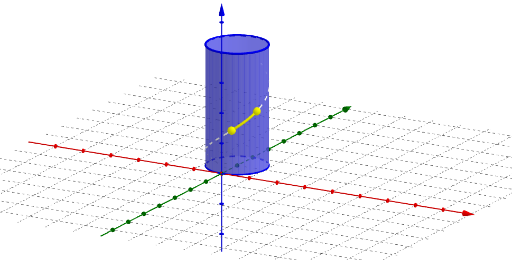
This example visualizes how to construct the shortest connection between two points on a cylindrical surface, illustrating the geodesic idea. The key mathematics includes: geodesics on a cylinder, unfolding a cylindrical surface to a plane so that the straight segment becomes the shortest path, distance preservation, and reflection/symmetry arguments for identifying the correct wrap-around. It also uses parameterization with angular variables and trigonometric relations (e.g., sine-related terms) where needed for coordinate relationships. Construction highlights from the GeoGebra command set: Circle with Radius, Rotate, and CircleArc to set up the cylinder cross-section and the angular parameterization; Segment and Line to draw candidate shortest connections; OrthogonalLine for perpendicular/auxiliary geometric relations; Point and PointIn together with If for selecting/intersecting the relevant points; Cylinder and Surface to generate the cylindrical geometry; Polygon to represent an unfolded/constructed region; Translate combined with the reflection/unfolding workflow to map the surface path into a planar straight segment; CurveCartesian to represent parameterized curves. The resulting visualization helps students reason about “shortest on a curved surface” using geometric unfolding and symmetry, making it suitable for high-school to early undergraduate geometry and optimization topics.
GeoGebra Commands & Parameters
Circle(O, B, xOyPlane) → cCircle(M, B, xOyPlane) → dRadius(d) → RRotate(B, (r / R * 360°), M) → B'CircleArc(M, B, B', xOyPlane) → u_1Segment(B, B_1) → u_2OrthogonalLine(O, xOyPlane) → fPoint(f) → ACylinder(O, A, r) → zyl, e, Deckfl, mantelSurface((R * cos(u)), y(M) + (R * sin(u)), v, u, -90°, α - 90°, v, 0, H) → flPolygon((0, 0, 0), (0, (-H), 0), (((2 * r) * pi), (-H), 0), (((2 * r) * pi), 0, 0)) → v1, i, j, k, lRotate(v1, 270° + ((t - 1) * 90°), xAxis) → v1'Rotate(C, ((t - 1) * 90°), xAxis) → C'Line(C', C' + (1, 0, 0)) → gRotate(Translate[Deckfl, Vector[C' - C]], ((2 * (t - 1)) * 90°), g) → Deckfl'Translate(u_1, Vector[(0, 0, H)]) → u_1'Translate(B', Vector[(0, 0, H)]) → B''Segment(B', B'') → mOrthogonalLine(M, xOyPlane) → drehPointIn(mantel) → DPointIn(mantel) → EIf(y(D) < r, (-1 * Angle[(1, r, z(D)), D_O, D]), (1 * Angle[(1, r, z(D)), D_O, D])) → α_DCircleArc(D_O, D', D) → bog_DIf(x(D) < 0, ((-bog_D), 0, z(D)), (bog_D, 0, z(D))) → D_1If(x(D) < 0, Rotate[D', ((-360°) / (((2 * r) * pi)) * bog_D / R), dreh], Rotate[D', ((360°) / (((2 * r) * pi)) * bog_D / R), dreh]) → D''CircleArc(E_O, E', E) → bog_EIf(x(E) < 0, ((-bog_E), 0, z(E)), (bog_E, 0, z(E))) → E_1If(x(E) < 0, Rotate[E', ((-360°) / (((2 * r) * pi)) * bog_E / R), dreh], Rotate[E', ((360°) / (((2 * r) * pi)) * bog_E / R), dreh]) → E''If(y(E) < r, (-1 * Angle[(1, r, z(E)), E_O, E]), (1 * Angle[(1, r, z(E)), E_O, E])) → α_ERotate(D_1, ((t - 1) * 90°), xAxis) → D_2Rotate(E_1, ((t - 1) * 90°), xAxis) → E_2Segment(D_2, E_2) → str1CurveCartesian((r * cos(α_D + (t * (α_E - α_D)))), r + (r * sin(α_D + (t * (α_E - α_D)))), z(D) + (t * (z(E) - z(D))), t, 0, 1) → spiral_1If(y(D'') < y(M), (-1 * Angle[(1, R, z(D)), D_M, D'']), (1 * Angle[(1, R, z(D)), D_M, D''])) → α_{DM}If(y(E'') < y(M), (-1 * Angle[(1, R, z(E)), E_M, E'']), (1 * Angle[(1, R, z(E)), E_M, E''])) → α_{EM}CurveCartesian((R * cos(α_{DM} + (t * (α_{EM} - α_{DM})))), R + (R * sin(α_{DM} + (t * (α_{EM} - α_{DM})))), z(D'') + (t * (z(E'') - z(D''))), t, 0, 1) → spiral_2CurveCartesian((r * cos(α_D + (t * (α_E - α_D)))), r + (r * sin(α_D + (t * (α_E - α_D)))), z(D) + (t * (z(E) - z(D))), t, (-pi), pi) → spiral_3Line(D_2, E_2) → h
AI Drawing Prompt Reference
Show a geometric illustration of the shortest path between two points on a cylindrical surface. The illustration includes a cylinder whose surface is unfolded into a plane. Two points are marked on the unfolded plane, and the straight line connecting them represents the shortest path (geodesic). Auxiliary lines, such as lines perpendicular to the cylinder's axis, and circular arcs for parameterization are also shown. The path may be represented by a spiral curve to illustrate the connection. The overall figure aims to explain the geometric principle of finding the shortest path by unfolding and reflecting the cylinder.
The prompt above was compiled from the original drawing commands and is for reference only.