
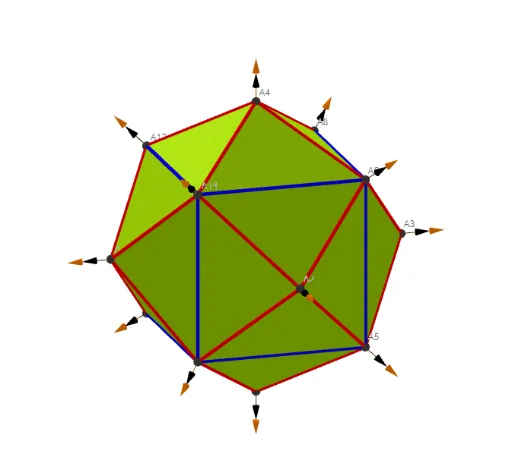
Tetrakis hexahedron with 14 vertices: a GeoGebra construction
Loading the math board and drawing, please wait…
This example demonstrates the geometric construction and visualization of the Tetrakis hexahedron, highlighting its structure by explicitly building the polyhedron with 14 vertices. It focuses on core topics in solid geometry and polyhedral structure: how vertices and edges define a 3D solid, how points can be placed using spherical reference geometry (Sphere), and how the resulting connections reflect symmetry in a coordinate/vector-based construction. Construction-wise, it uses GeoGebra commands such as UnicodeToLetter and Text for labeling, TableText and Sum for tabular/statistical presentation, Sphere to provide the geometric reference, and a network of point and segment objects (e.g., Points00, lll*, Segments, n) to generate and connect the vertex set into the final polyhedral edges. Suitable for upper-secondary and early university learners, as well as for teaching/learning geometry construction workflows and verifying polyhedron properties visually.
GeoGebra Commands & Parameters
UnicodeToLetter(34) → u34Text("" + Um1) → txt_pSum(Flatten[Sequence[Append[Sequence[Element[txt_p, i], i, m01(k), m02(k)], " "], k, 1, 5]]) → txtUm1Zip(Vector[a, a + UnitVector[a]], a, Points00) → lVector1Zip(Vector[a, a + (1.5 * UnitVector[b])], a, Points00, b, Wi_Pc) → lVector2Zip(Vector[a, a + (1.5 * UnitVector[b])], a, Points00, b, Wi_P) → lVector3Sphere((0, 0, 0), 5) → sphTableText(Append["i", 1…n], Append[" \fgcolor{orange}{GM :Δφ_i}, rad", l1w], Append["\fgcolor{magenta}{GC :Δφ_i} , rad", l1cw], "v") → text23rZip(Segment[Element[Points00, y(a)], Element[Points00, z(a)]], a, ll1bb(1)) → ll1Zip(Segment[Element[Points00, y(a)], Element[Points00, z(a)]], a, ll1bb(2)) → ll2Zip(Segment[Element[Points00, y(a)], Element[Points00, z(a)]], a, ll1bb(3)) → ll3Zip(Segment[Element[Points00, y(a)], Element[Points00, z(a)]], a, ll1bb(4)) → ll4Zip(Segment[Element[Points00, y(a)], Element[Points00, z(a)]], a, ll1bb(5)) → ll5Zip(Segment[Element[Points00, y(a)], Element[Points00, z(a)]], a, ll1bb(6)) → ll6
AI Drawing Prompt Reference
Draw a 3D tetrakis hexahedron with 14 vertices. Start with a reference sphere centered at the origin with radius 5. Place 14 vertices on or near the sphere, arranged with cubic symmetry. Connect these vertices with line segments according to a specific pattern to form the polyhedron's edges, resulting in a convex solid composed of triangular faces. Include vertex labels and auxiliary vectors to show directional relationships between vertices, and optionally add a table summarizing angle variations. Emphasize the symmetric structure and the geometric construction process.
The prompt above was compiled from the original drawing commands and is for reference only.