
Tessellation of a General Quadrilateral by Michael Borcherds
Loading the math board and drawing, please wait…
In collections
Unit 7: Polygons and Quadrilaterals
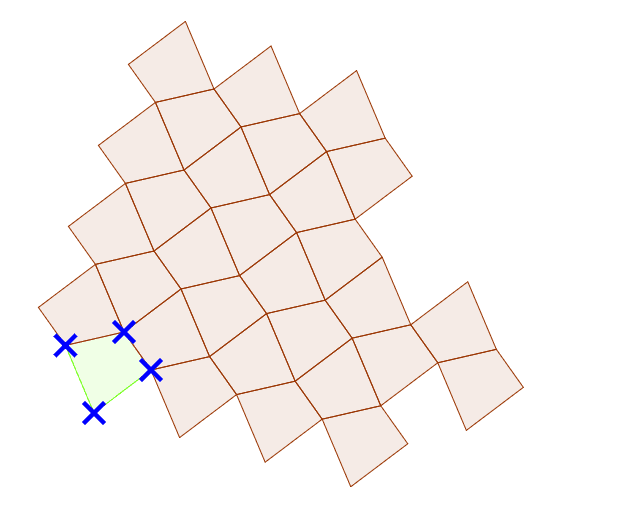
This example demonstrates how to tessellate a general quadrilateral to showcase geometric patterns and spatial filling. It involves core mathematical concepts such as angles, area, congruence, quadrilateral properties, difference and slope, number calculations, intersections, and volume. The construction uses GeoGebra commands like Polygon, Vector, Translate, and Mirror. Suitable for high school students to explore the principles and applications of tessellations in mathematics and interest groups.
GeoGebra Commands & Parameters
Polygon(A, B, C, D) → poly1, a_1, b_1, c_1, d_1Vector(A, B) → uTranslate(A, u) → A'Translate(B, u) → B'Translate(C, u) → C'Translate(D, u) → D'Polygon(A', B', C', D') → poly1', a', b', c', d'Mirror(A', A') → A''Mirror(B', A') → B''Mirror(C', A') → C''Mirror(D', A') → D''Polygon(A'', B'', C'', D'') → poly1'', a'', b'', c'', d''Polygon(I, J, K, L) → poly2, j, i, h, gVector(I, J) → vTranslate(I, v) → MTranslate(J, v) → NTranslate(K, v) → OTranslate(L, v) → PPolygon(M, N, O, P) → poly4, r, s, p, qMirror(M, M) → EMirror(N, M) → FMirror(O, M) → GMirror(P, M) → HPolygon(E, F, G, H) → poly3, n, m, l, kPolygon(U, V, W, Z) → poly5, g_1, f_1, e_1, tVector(U, V) → wTranslate(U, w) → A_1Translate(V, w) → B_1Translate(W, w) → C_1Translate(Z, w) → D_1Polygon(A_1, B_1, C_1, D_1) → poly7, n_1, p_1, l_1, m_1Mirror(A_1, A_1) → QMirror(B_1, A_1) → RMirror(C_1, A_1) → SMirror(D_1, A_1) → TPolygon(Q, R, S, T) → poly6, k_1, j_1, i_1, h_1Polygon(I_1, J_1, K_1, L_1) → poly8, t_1, s_1, r_1, q_1Vector(I_1, J_1) → zTranslate(I_1, z) → M_1Translate(J_1, z) → N_1Translate(K_1, z) → O_1Translate(L_1, z) → P_1Polygon(M_1, N_1, O_1, P_1) → poly10, g_2, h_2, e_2, f_2Mirror(M_1, M_1) → E_1Mirror(N_1, M_1) → F_1Mirror(O_1, M_1) → G_1Mirror(P_1, M_1) → H_1Polygon(E_1, F_1, G_1, H_1) → poly9, d_2, c_2, b_2, a_2Polygon(U_1, V_1, W_1, Z_1) → poly11, l_2, k_2, j_2, i_2Vector(U_1, V_1) → u_1Translate(U_1, u_1) → A_2Translate(V_1, u_1) → B_2Translate(W_1, u_1) → C_2Translate(Z_1, u_1) → D_2Polygon(A_2, B_2, C_2, D_2) → poly13, t_2, a_3, r_2, s_2Mirror(A_2, A_2) → Q_1Mirror(B_2, A_2) → R_1Mirror(C_2, A_2) → S_1Mirror(D_2, A_2) → T_1Polygon(Q_1, R_1, S_1, T_1) → poly12, q_2, p_2, n_2, m_2Polygon(I_2, J_2, K_2, L_2) → poly14, e_3, d_3, c_3, b_3Vector(I_2, J_2) → v_1Translate(I_2, v_1) → M_2Translate(J_2, v_1) → N_2Translate(K_2, v_1) → O_2Translate(L_2, v_1) → P_2Polygon(M_2, N_2, O_2, P_2) → poly16, l_3, m_3, j_3, k_3Mirror(M_2, M_2) → E_2Mirror(N_2, M_2) → F_2Mirror(O_2, M_2) → G_2Mirror(P_2, M_2) → H_2Polygon(E_2, F_2, G_2, H_2) → poly15, i_3, h_3, g_3, f_3Polygon(U_2, V_2, W_2, Z_2) → poly17, r_3, q_3, p_3, n_3Vector(U_2, V_2) → w_1Translate(U_2, w_1) → A_3Translate(V_2, w_1) → B_3Translate(W_2, w_1) → C_3Translate(Z_2, w_1) → D_3Polygon(A_3, B_3, C_3, D_3) → poly19, e_4, f_4, c_4, d_4Mirror(A_3, A_3) → Q_2Mirror(B_3, A_3) → R_2Mirror(C_3, A_3) → S_2Mirror(D_3, A_3) → T_2Polygon(Q_2, R_2, S_2, T_2) → poly18, b_4, a_4, t_3, s_3Polygon(I_3, J_3, K_3, L_3) → poly20, j_4, i_4, h_4, g_4Vector(I_3, J_3) → z_1Translate(I_3, z_1) → M_3Translate(J_3, z_1) → N_3Translate(K_3, z_1) → O_3Translate(L_3, z_1) → P_3Polygon(M_3, N_3, O_3, P_3) → poly22, r_4, s_4, p_4, q_4Mirror(M_3, M_3) → E_3Mirror(N_3, M_3) → F_3Mirror(O_3, M_3) → G_3Mirror(P_3, M_3) → H_3Polygon(E_3, F_3, G_3, H_3) → poly21, n_4, m_4, l_4, k_4Polygon(U_3, V_3, W_3, Z_3) → poly23, c_5, b_5, a_5, t_4Vector(U_3, V_3) → u_2Translate(U_3, u_2) → A_4Translate(V_3, u_2) → B_4Translate(W_3, u_2) → C_4Translate(Z_3, u_2) → D_4Polygon(A_4, B_4, C_4, D_4) → poly25, j_5, k_5, h_5, i_5Mirror(A_4, A_4) → Q_3Mirror(B_4, A_4) → R_3Mirror(C_4, A_4) → S_3Mirror(D_4, A_4) → T_3Polygon(Q_3, R_3, S_3, T_3) → poly24, g_5, f_5, e_5, d_5Polygon(I_4, J_4, K_4, L_4) → poly26, p_5, n_5, m_5, l_5Vector(I_4, J_4) → v_2Translate(I_4, v_2) → M_4Translate(J_4, v_2) → N_4Translate(K_4, v_2) → O_4Translate(L_4, v_2) → P_4Polygon(M_4, N_4, O_4, P_4) → poly28, c_6, d_6, a_6, b_6Mirror(M_4, M_4) → E_4Mirror(N_4, M_4) → F_4Mirror(O_4, M_4) → G_4Mirror(P_4, M_4) → H_4Polygon(E_4, F_4, G_4, H_4) → poly27, t_5, s_5, r_5, q_5Polygon(U_4, V_4, W_4, Z_4) → poly29, h_6, g_6, f_6, e_6Vector(U_4, V_4) → w_2Translate(U_4, w_2) → A_5Translate(V_4, w_2) → B_5Translate(W_4, w_2) → C_5Translate(Z_4, w_2) → D_5Polygon(A_5, B_5, C_5, D_5) → poly31, p_6, q_6, m_6, n_6Mirror(A_5, A_5) → Q_4Mirror(B_5, A_5) → R_4Mirror(C_5, A_5) → S_4Mirror(D_5, A_5) → T_4Polygon(Q_4, R_4, S_4, T_4) → poly30, l_6, k_6, j_6, i_6Polygon(I_5, J_5, K_5, L_5) → poly32, a_7, t_6, s_6, r_6Vector(I_5, J_5) → z_2Translate(I_5, z_2) → M_5Translate(J_5, z_2) → N_5Translate(K_5, z_2) → O_5Translate(L_5, z_2) → P_5Polygon(M_5, N_5, O_5, P_5) → poly34, h_7, i_7, f_7, g_7Mirror(M_5, M_5) → E_5Mirror(N_5, M_5) → F_5Mirror(O_5, M_5) → G_5Mirror(P_5, M_5) → H_5Polygon(E_5, F_5, G_5, H_5) → poly33, e_7, d_7, c_7, b_7Polygon(U_5, V_5, W_5, Z_5) → poly35, m_7, l_7, k_7, j_7Vector(U_5, V_5) → u_3Translate(U_5, u_3) → A_6Translate(V_5, u_3) → B_6Translate(W_5, u_3) → C_6Translate(Z_5, u_3) → D_6Polygon(A_6, B_6, C_6, D_6) → poly37, a_8, b_8, s_7, t_7Mirror(A_6, A_6) → Q_5Mirror(B_6, A_6) → R_5Mirror(C_6, A_6) → S_5Mirror(D_6, A_6) → T_5Polygon(Q_5, R_5, S_5, T_5) → poly36, r_7, q_7, p_7, n_7Polygon(I_6, J_6, K_6, L_6) → poly38, f_8, e_8, d_8, c_8Vector(I_6, J_6) → v_3Translate(I_6, v_3) → M_6Translate(J_6, v_3) → N_6Translate(K_6, v_3) → O_6Translate(L_6, v_3) → P_6Polygon(M_6, N_6, O_6, P_6) → poly40, m_8, n_8, k_8, l_8Mirror(M_6, M_6) → E_6Mirror(N_6, M_6) → F_6Mirror(O_6, M_6) → G_6Mirror(P_6, M_6) → H_6Polygon(E_6, F_6, G_6, H_6) → poly39, j_8, i_8, h_8, g_8Polygon(U_6, V_6, W_6, Z_6) → poly41, s_8, r_8, q_8, p_8Vector(U_6, V_6) → w_3Translate(U_6, w_3) → A_7Translate(V_6, w_3) → B_7Translate(W_6, w_3) → C_7Translate(Z_6, w_3) → D_7Polygon(A_7, B_7, C_7, D_7) → poly43, f_9, g_9, d_9, e_9Mirror(A_7, A_7) → Q_6Mirror(B_7, A_7) → R_6Mirror(C_7, A_7) → S_6Mirror(D_7, A_7) → T_6Polygon(Q_6, R_6, S_6, T_6) → poly42, c_9, b_9, a_9, t_8
AI Drawing Prompt Reference
Draw a tessellation pattern created by translating and reflecting a general quadrilateral, showcasing geometric transformations and spatial filling. Start by drawing a quadrilateral, then translate it along one of its sides to create another quadrilateral. Reflect both quadrilaterals, and combine the mirrored shapes to form a complex tessellated pattern, demonstrating the principles and aesthetics of geometric transformations.
The prompt above was compiled from the original drawing commands and is for reference only.