
Ten Moving Points Induce Two Antipodal Geometric Centers on a Sphere
Loading the math board and drawing, please wait…
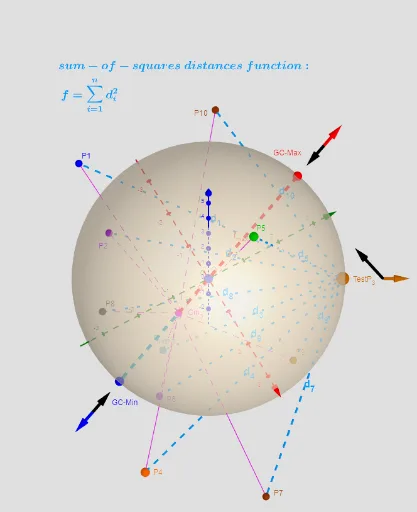
① This applet demonstrates a dynamic geometric phenomenon: ten freely moving points in space induce two geometric centers on a sphere, which are antipodal (opposite ends of a diameter). ② The core mathematical concepts involve spherical geometry, antipodal points, generalized geometric centers (such as centroid or barycenter), and symmetry in multi-point systems. ③ Construction highlights: based on the construction summary, the applet uses GeoGebra commands including Polygon, PointIn, Sphere, Circle, Angle, Zip, Sum, PolyLine, Flatten, Textfield, KeepIf, Function, Sequence, CurveCartesian, Vector, Segment, Translate, and RotateText, creating multiple points (P1 to P10), a sphere, auxiliary circles, and vectors, with dynamic computation yielding the two centers. ④ Suitable for high school to university-level mathematics teaching, useful for exploring geometric properties of point systems, spherical geometry, and symmetry, as well as a demonstration of dynamic geometry and computer-assisted instruction.
GeoGebra Commands & Parameters
Polygon({B01, B02, B04, B03}) → q2PointIn(q2) → B1PointIn(q2) → B2PointIn(q2) → B3PointIn(q2) → B4PointIn(q2) → B5PointIn(q2) → B6PointIn(q2) → B7PointIn(q2) → B8PointIn(q2) → B9PointIn(q2) → B10First({P1, P2, P3, P4, P5, P6, P7, P8, P9, P10}, n) → lPPolygon({((-π), ((-π)) / 2), ((-π), π / 2), (π, π / 2), (π, ((-π)) / 2)}) → qPointIn(q) → A_2Sphere(O, R) → bCircle(O, R, xOyPlane) → cAngle(sumunitA_q, vA) → αAZip(Segment[A, p], p, lP) → segSum(seg) → sum_segPolyLine({((-π), ((-π)) / 2), ((-π), π / 2), (π, π / 2), (π, ((-π)) / 2), ((-π), ((-π)) / 2)}) → q1Flatten(Sequence[Sequence[((-π) + ((2 * π / na) * i), ((-π)) / 2 + (π / na * j)), j, 1, na - 1], i, 1, na - 1]) → ltest_2Zip((R; x(a); y(a)), a, ltest_2) → ltest_3Zip((arg(a), alt(a)), a, lP) → lP_2Textfield(n) → InputBox11KeepIf(x > 0, Sequence[If[abs(Element[αsad, i] - π) < 0.001 ∨ abs(Element[αsad, i]) < 0.001, i, 0], i, 1, Length[αsad]]) → NαsadTextfield(R) → InputBox1Textfield(na) → InputBox2Function(f01, (-π), π, ((-π)) / 2, π / 2) → f0Sequence(Vector[(1.3 * Point[O, Vector[Element[sumunit_sad, i]]]), (1.5 * Point[O, Vector[Element[sumunit_sad, i]]])], i, 1, Length[sumunit_sad]) → sumunit_sad1Zip((Length[a]; arg(a); alt(a)), a, lP) → lPsphereCurveCartesian((-π) + ((2 * π) * a), ((-π)) / 2, f0((-π) + ((2 * π) * a), ((-π)) / 2), a, 0, 1) → par1CurveCartesian((-π) + ((2 * π) * a), π / 2, f0((-π) + ((2 * π) * a), π / 2), a, 0, 1) → par2CurveCartesian(π, ((-π)) / 2 + (π * a), f0(π, ((-π)) / 2 + (π * a)), a, 0, 1) → par4Zip(Text["d_{" + (a) + "}", (A + Element[lP, a]) / 2], a, 1…n) → lPtxtCurveCartesian((-π), ((-π)) / 2 + (π * a), f0((-π), ((-π)) / 2 + (π * a)), a, 0, 1) → par3Zip((x(a), y(a)), a, lP) → lP_{Gr1}First({aP1, aP2, aP3, aP4, aP5, aP6, aP7, aP8, aP9, aP10}, n) → OutputVector((1.3 * A), (1.5 * A)) → lvA_aZip(Segment[F_o, p], p, lP) → segF_oSum(segF_o) → sum_segFoSum(seg^(2)) → sum_qVector((1.3 * A), (1.1 / 1.7 * Point[O, Vector[(-sumunitA_q)]])) → l1A_qVector((1.3 * Zq), (1.5 * Zq)) → lvZqVector((1.3 * Zq'), (1.5 * Zq')) → lvZq'Vector((1.3 * Zq), (1.1 / 1.7 * Point[O, Vector[(-sumunitZ_q)]])) → l1Z_qVector((1.3 * Zq'), (1.1 / 1.7 * Point[O, Vector[(-sumunitZ_q')]])) → l1Z_q'Segment(Zq, Zq') → antipodalAchseSegment(Zq, Cm_0) → segZqSegment(Zq', Cm_0) → segZq'Zip(Segment[Cm_0, p], p, lP) → segC_mSum(Zip[a^(2), a, segC_m]) → sum_segCmoqZip(Text["P_{" + (a) + "}", b + (0.1, 0.1)], a, 1…n, b, lP_2) → l1Zip(Segment[(x(a), y(a), -1), (x(a), y(a), f0(x(a), y(a)))], a, {((-π), ((-π)) / 2), ((-π), π / 2), (π, π / 2), (π, ((-π)) / 2)}) → lsegTranslate(q, Vector[(0, 0, -1)]) → q'RotateText(txt, 90°) → txt1
AI Drawing Prompt Reference
Draw a sphere with ten freely moving points on its surface, which generate two antipodal geometric centers. First, create a sphere. Then, place ten points on the sphere. Next, calculate the positions of these points to find the two antipodal geometric centers. Finally, display these two center points.
The prompt above was compiled from the original drawing commands and is for reference only.