
Surface & Prisms
Loading the math board and drawing, please wait…
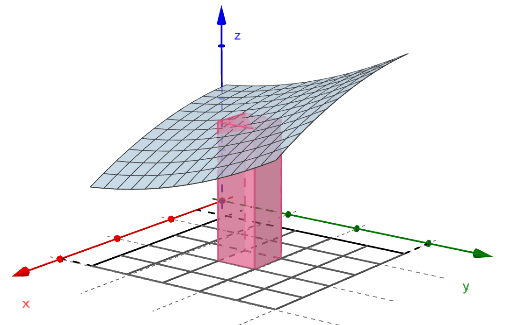
This example demonstrates how to use GeoGebra to draw prisms and surface graphs, showcasing their geometric properties. The core math concepts involved include solid geometry, surface area calculation, prism structure, etc. It utilizes commands and objects like Point, Vector, Ray, Segment, Sequence, Mod, Polygon, Prism, Surface, Length. Suitable for high school students learning and understanding solid geometry, surface, and prism related knowledge.
GeoGebra Commands & Parameters
Point(b) → AVector((0, 0), (1, 0)) → uRay(A, u) → cPoint(c) → BVector((0, 0), (0, 1)) → vPoint(a) → CRay(C, v) → dPoint(d) → DSegment(D, G) → eSegment(C, E) → gSegment(E, A) → hSegment(F, B) → iSegment(G, H) → jSegment(H, F) → k_1Segment(F, E) → lSegment(E, G) → mSequence(Segment[(x(E), y(E) + (t * (y(G) - y(E)) / n)), (x(F), y(E) + (t * (y(G) - y(E)) / n))], t, 1, n) → list1Sequence(Segment[(x(E) + (t * (x(F) - x(E)) / n), y(E)), (x(E) + (t * (x(F) - x(E)) / n), y(G))], t, 1, n) → list2Mod(k, n) → jjPolygon(I, (x(I) + (x(F) - x(E)) / n, y(I)), (x(I) + (x(F) - x(E)) / n, y(I) + (y(G) - y(E)) / n), (x(I), y(I) + (y(G) - y(E)) / n)) → poly1, i_1, p, q, rPrism(poly1, f(x(I), y(I))) → o, J, edgeIJ, edge1, edge2, edge3, edgeJK, edgeKL, edgeLM, edgeJM, K, L, M, face1, face3, face4, face2, faceJKLMSequence(Sequence[Prism[Polygon[(x(E) + (t * (x(F) - x(E)) / n), y(E) + (s * (y(G) - y(E)) / n)), (x(E) + ((t + 1) * (x(F) - x(E)) / n), y(E) + (s * (y(G) - y(E)) / n)), (x(E) + ((t + 1) * (x(F) - x(E)) / n), y(E) + ((s + 1) * (y(G) - y(E)) / n)), (x(E) + (t * (x(F) - x(E)) / n), y(E) + ((s + 1) * (y(G) - y(E)) / n))], f(x(E) + (t * (x(F) - x(E)) / n), y(E) + (s * (y(G) - y(E)) / n))], s, 0, n - 1], t, 0, n - 1) → list3, {{5.040634849275378, 5.222719616182059, 5.535827348675121, 5.979958046754571, 6.555111710420408}, {4.853204377868443, 5.035289144775126, 5.348396877268191, 5.792527575347633, 6.36768123901347}, {4.541488460180978, 4.723573227087656, 5.036680959580726, 5.480811657660173, 6.055965321326014}, {4.105487096212984, 4.287571863119662, 4.600679595612727, 5.0448102936921835, 5.619963957357996}, {3.5452002859644463, 3.727285052871138, 4.0403927853641814, 4.484523483443652, 5.059677147109483}}Surface(u_{1}, v_{1}, f(u_{1}, v_{1}), u_{1}, x(A), x(B), v_{1}, y(C), y(D)) → tLength(list3) → w
AI Drawing Prompt Reference
Draw a quadrilateral prism with a parallelogram base and a parallel parallelogram top, where the bases are parallel and corresponding sides are parallel. First, define the four vertices A, B, C, D of the base in the coordinate system, then define the four vertices E, F, G, H of the top, ensuring that E, F, G, H are parallel to A, B, C, D respectively. Finally, connect the corresponding sides of the base and top to form the prism's lateral faces.
The prompt above was compiled from the original drawing commands and is for reference only.