
Surface of Revolution by Steve Phelps
Loading the math board and drawing, please wait…
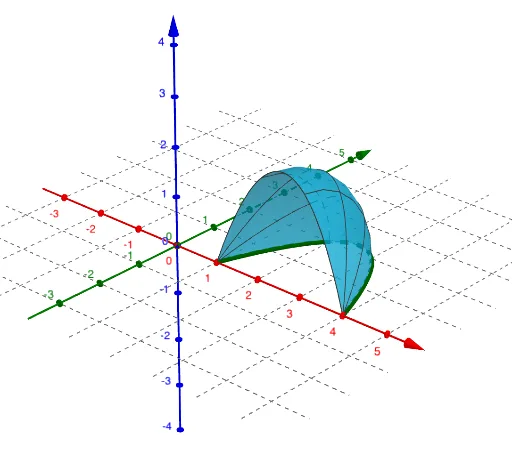
This example demonstrates how to generate a three-dimensional surface of revolution by rotating a two-dimensional curve. It involves core calculus concepts such as surface generation, function graphs, and their transformations. The construction uses GeoGebra's Surface command with objects f (function), n (rotation parameter), and a (axis parameter). Suitable for high school and above students learning calculus, spatial geometry, and exploring the geometric properties of function graphs.
GeoGebra Commands & Parameters
Surface(f, n, xAxis) → a
AI Drawing Prompt Reference
Create a 3D surface formed by rotating a 2D function curve around the horizontal axis. The curve lies in a coordinate plane and its shape is defined by a function. Rotating it generates a symmetric solid, like a vase or horn. The rotation extent is controlled by a parameter, allowing partial or full revolution. The axis serves as the rotation axis, and the surface extends along it. Include both the original curve and the generated surface to show their relationship. The result should be a smooth geometric solid illustrating the concept of a surface of revolution.
The prompt above was compiled from the original drawing commands and is for reference only.