
Surface Area of Cylinders
Loading the math board and drawing, please wait…
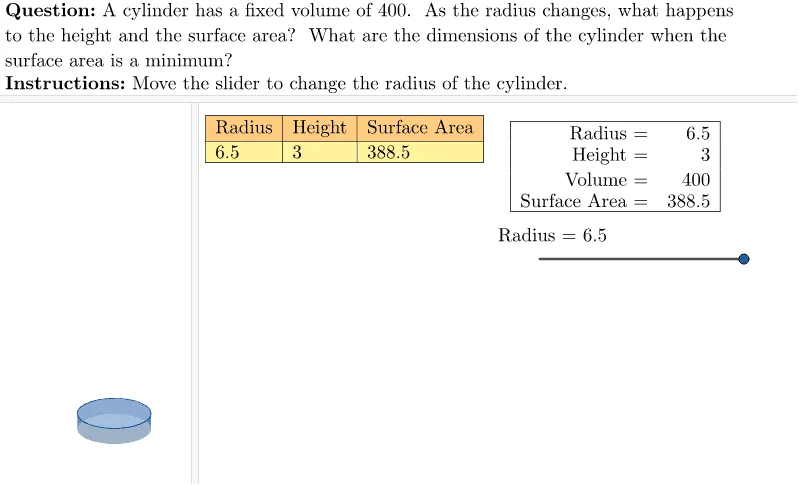
This example demonstrates the calculation of the surface area of cylinders. Key mathematical concepts include the geometric properties and area formulas of cylinders. Using GeoGebra commands such as Zip, Point, and Segment, users can dynamically adjust the radius and height of the cylinder to observe changes in the surface area. Suitable for middle school and above students learning geometry and area calculation.
GeoGebra Commands & Parameters
Zip((A, sliderYval), A, validXvals) → sliderPointsPoint(sliderPoints) → SIndexOf(x(S), validXvals) → currRowJoin({Sequence["white", i, 1, currRow - 1], {"#fff59d"}, Sequence["white", i, currRow + 1, Max[13, maxRadius + 1]]}) → RowColoursSequence(Sequence[(((("\cellcolor{" * Element[RowColours, j]) * "}{") * Element[tblVals, i, j]) * "}"), i, 1, 3], j, 1, maxRow) → ListDataJoin({ListHeader, ListData}) → FullListTableText(FullList, "|111_111111111111l") → displayTblLaTeX("\text{\textbf{Instructions: }Move the slider to change the radius of the cylinder.}") → SpecInstrucElement(First[sliderPoints], 1) → sliderEndSegment(sliderStart, sliderEnd) → mySliderTableText({{LaTeX["\text{Radius =}"], currRadius}, {LaTeX["\text{Height =}"], height}, {LaTeX["\text{Volume =}"], fixedVolume}, {LaTeX["\text{Surface Area =}"], currSA}}, "|101 _1000 r") → currStatsDispCylinder(Circle[(0, 0, -25), currRadius, xOyPlane], height) → a_2, a_2, a_3LaTeX("\text{\textbf{Question: }A cylinder has a fixed volume of 400. As the radius changes, what happens \\to the height and the surface area? What are the dimensions of the cylinder when the \\surface area is a minimum?}") → MainInstruc