
Sum of the Interior Angles in a Pentagon
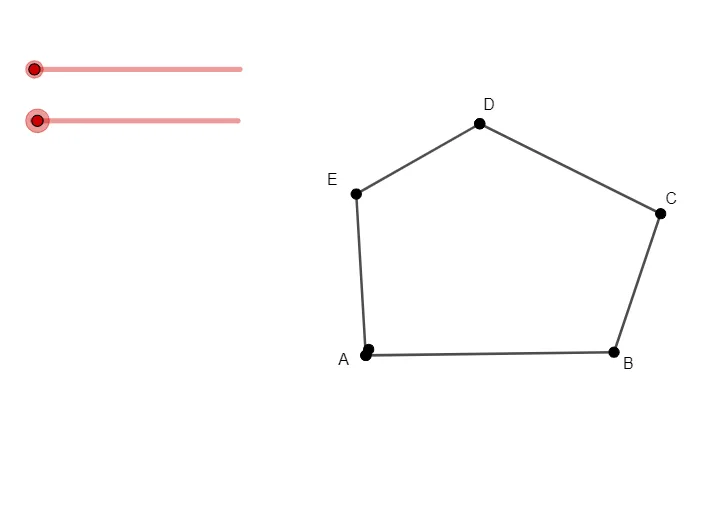
Loading the math board and drawing, please wait…
In collections
Sum of Interior Angles in a Polygon
① This example dynamically demonstrates that the sum of interior angles in a pentagon is always 540°. ② The core mathematical concept is the polygon interior angle sum formula (n-2)×180°, along with the triangulation method—dividing the pentagon into three triangles to derive the total. ③ Construction highlights: using GeoGebra's Segment command to connect vertices A, B, C, D, E forming the pentagon, and Point command to create auxiliary points (e.g., E₁) that support internal diagonals (k, i, l) for triangulation; objects include segments f, g, h, a, b, j and points F, G for labeling and interaction. ④ Suitable for middle school geometry lessons or high school review, ideal for classroom demonstration, student exploration of the angle sum formula, or as a dynamic worksheet resource.
GeoGebra Commands & Parameters
Segment(A, B) → fSegment(B, C) → gSegment(C, D) → hPoint(Circle[A, a]) → E_{1}Segment(A, E_{1}) → kSegment(D, E) → iSegment(E, A) → lPoint(Circle[A, Distance[A, D]]) → FPoint(Circle[A, b]) → GSegment(A, G) → j
AI Drawing Prompt Reference
Draw a pentagon by connecting five vertices. Inside the pentagon, create three triangles by using auxiliary points and drawing diagonals from vertices to internal points. Label the interior angles of each triangle and display the sum of the interior angles of the pentagon to demonstrate it is always 540 degrees.
The prompt above was compiled from the original drawing commands and is for reference only.