
Sum of Interior Angles in an Octagon
Loading the math board and drawing, please wait…
In collections
Sum of Interior Angles in a Polygon
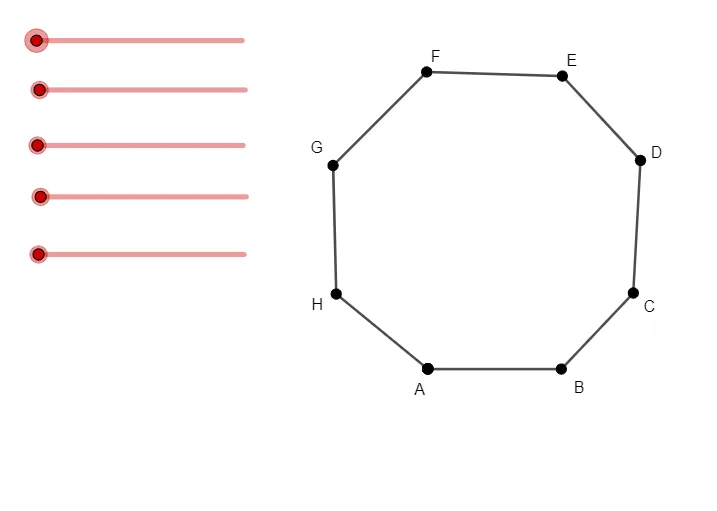
This example demonstrates how to calculate the sum of interior angles in an octagon through dynamic visualization. Key math concepts include polygon angle sum formula, angle calculation, and geometric construction. It uses commands like Segment and Point from GeoGebra. Suitable for middle school and above students to learn and understand the polygon angle sum theorem, ideal for geometry teaching and visual demonstration.
GeoGebra Commands & Parameters
Segment(A, B) → fSegment(B, C) → gSegment(C, D) → hSegment(D, E) → iSegment(E, F) → jSegment(F, G) → kSegment(G, H) → lSegment(H, A) → mPoint(Circle[A, a]) → ISegment(A, I) → nPoint(Circle[A, b]) → JSegment(A, J) → pPoint(Circle[A, c]) → KSegment(A, K) → qPoint(Circle[A, d]) → LSegment(A, L) → rPoint(Circle[A, e]) → MSegment(A, M) → s
AI Drawing Prompt Reference
Draw a closed octagon by connecting consecutive vertices with eight straight segments in order. Use one circle as a reference: place five points on the same circle. From the starting vertex, draw segments to each of these five circle points, creating multiple auxiliary rays/lines that emanate from the same vertex. Show the octagon edges together with these constructed segments to visually support reasoning about the sum of interior angles of an octagon.
The prompt above was compiled from the original drawing commands and is for reference only.