
Sum of Interior Angles in a Heptagon
Loading the math board and drawing, please wait…
In collections
Sum of Interior Angles in a Polygon
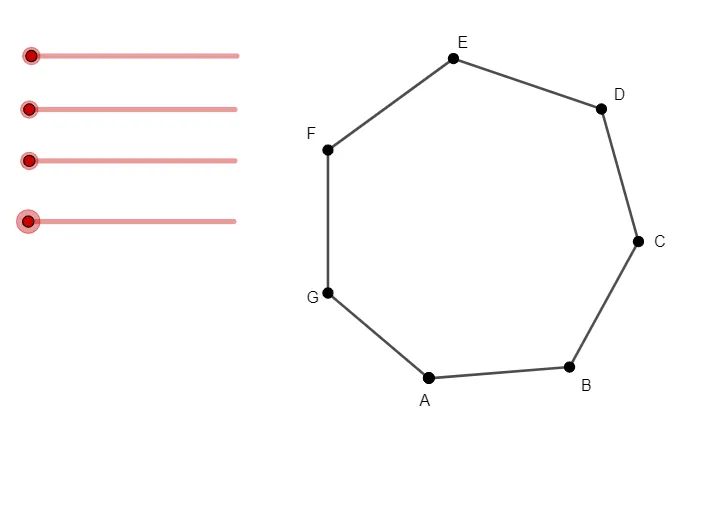
This example demonstrates the sum of interior angles in a heptagon. The key mathematical concept involved is the formula for the sum of interior angles of a polygon. Using GeoGebra commands such as Segment and Point, a heptagon is constructed, and its interior angle sum is calculated. Suitable for middle school and above students to learn about the sum of interior angles of polygons.
GeoGebra Commands & Parameters
Segment(A, B) → fSegment(B, C) → gSegment(C, D) → hSegment(D, E) → iSegment(E, F) → jSegment(F, G) → kSegment(G, A) → lPoint(Circle[A, a]) → HSegment(A, H) → mPoint(Circle[A, b]) → ISegment(A, I) → nPoint(Circle[A, c]) → JSegment(A, J) → pPoint(Circle[A, d]) → KSegment(A, K) → q
AI Drawing Prompt Reference
Draw a heptagon with seven vertices connected in order to form a closed shape. From one vertex, draw four line segments to four non-adjacent vertices, dividing the heptagon into five triangles. These auxiliary segments radiate from the same vertex, creating a clear geometric structure with the heptagon's sides. The figure should show the complete division of the interior, illustrating the principle of calculating the sum of interior angles.
The prompt above was compiled from the original drawing commands and is for reference only.