
Sum of n Integers Demonstration
Loading the math board and drawing, please wait…
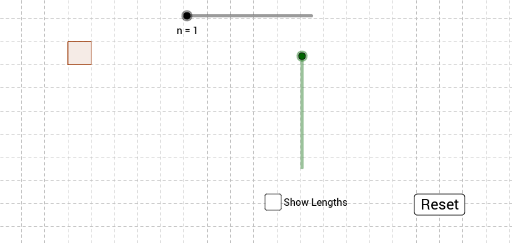
This example visually demonstrates the sum of n integers. Drag the n= slider to change the number of squares and the green slider to reveal the corresponding rectangle. It illustrates the concept of summing integers geometrically and dynamically, involving core math ideas like integer sums, sliding sums, and rectangle construction. Constructed using GeoGebra commands like Point, Polygon, Rotate, suitable for middle school and above to grasp the geometric meaning of sum formulas and dynamic changes.
GeoGebra Commands & Parameters
Point(yAxis) → EPolygon(E, F, 4) → poly2, e, f, g, h, G, HPolygon(F, I, 4) → poly3, i, j, k, l, J, KPoint(yAxis) → LPolygon(L, M, 4) → poly4, m, p, q, r, N, OPolygon(M, P, 4) → poly5, s, t, a_1, b_1, Q, RPolygon(P, S, 4) → poly6, c_1, d_1, e_1, f_1, T, UPoint(yAxis) → VPolygon(V, W, 4) → poly7, g_1, h_1, i_1, j_1, Z, A_1Polygon(W, B_1, 4) → poly8, k_1, l_1, m_1, n_1, C_1, D_1Polygon(B_1, E_1, 4) → poly9, p_1, q_1, r_1, s_1, F_1, G_1Polygon(E_1, H_1, 4) → poly10, t_1, a_2, b_2, c_2, I_1, J_1Point(yAxis) → K_1Polygon(K_1, L_1, 4) → poly11, d_2, e_2, f_2, g_2, M_1, N_1Polygon(L_1, O_1, 4) → poly12, h_2, i_2, j_2, k_2, P_1, Q_1Polygon(O_1, R_1, 4) → poly13, l_2, m_2, n_2, p_2, S_1, T_1Polygon(R_1, U_1, 4) → poly14, q_2, r_2, s_2, t_2, V_1, W_1Polygon(U_1, Z_1, 4) → poly15, a_3, b_3, c_3, d_3, A_2, B_2Point(yAxis) → C_2Polygon(C_2, D_2, 4) → poly16, e_3, f_3, g_3, h_3, E_2, F_2Polygon(D_2, G_2, 4) → poly17, i_3, j_3, k_3, l_3, H_2, I_2Polygon(G_2, J_2, 4) → poly18, m_3, n_3, p_3, q_3, K_2, L_2Polygon(J_2, M_2, 4) → poly19, r_3, s_3, t_3, a_4, N_2, O_2Polygon(M_2, P_2, 4) → poly20, b_4, c_4, d_4, e_4, Q_2, R_2Polygon(H, G, 4) → poly1, a, b, c, d, A, CRotate(poly1, α, RP) → poly1'Rotate(poly2, α, RP) → poly2'Rotate(poly3, α, RP) → poly3'Rotate(poly4, α, RP) → poly4'Rotate(poly5, α, RP) → poly5'Rotate(poly6, α, RP) → poly6'Rotate(poly7, α, RP) → poly7'Rotate(poly8, α, RP) → poly8'Rotate(poly9, α, RP) → poly9'Rotate(poly11, α, RP) → poly11'Rotate(poly12, α, RP) → poly12'Rotate(poly13, α, RP) → poly13'Rotate(poly14, α, RP) → poly14'Rotate(poly15, α, RP) → poly15'Rotate(poly16, α, RP) → poly16'Rotate(poly17, α, RP) → poly17'Rotate(poly18, α, RP) → poly18'Rotate(poly19, α, RP) → poly19'Polygon(P_2, S_2, 4) → poly21, f_4, g_4, h_4, i_4, D, T_2Rotate(poly21, α, RP) → poly21'Rotate(poly20, α, RP) → poly20'Rotate(poly10, α, RP) → poly10'