
Sum of Exterior Angles of a Polygon by Richard Miles
Loading the math board and drawing, please wait…
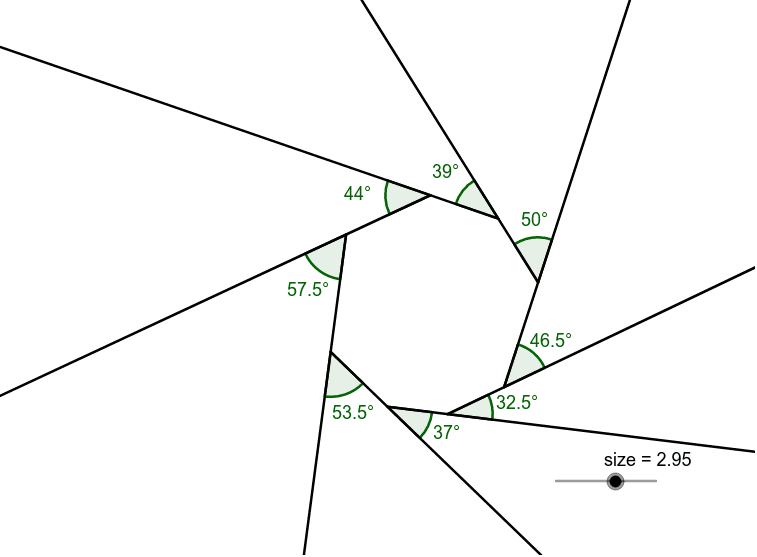
This example demonstrates the constant sum of exterior angles for any polygon. Key math concepts include exterior angles, polygon interior angle sum theorem, and polygon classification. Construction involves commands like Translate, Rotate, Circle, Ray, and Angle in GeoGebra to build polygons and their exterior angles. Suitable for middle school and above students to visually understand the theorem and its applications.
GeoGebra Commands & Parameters
Translate(A, Vector[(0, 0), (0, size)]) → A'Rotate(A', 50*°, A) → A''Rotate(A'', 65*°, A) → A'''Rotate(A''', 42*°, A) → BRotate(B, 32*°, A) → B'Rotate(B', 33*°, A) → B''Circle(A, size) → cRay(A', A'') → aRay(A'', A''') → bRay(A''', B) → dRay(B, B') → eRay(B', B'') → fAngle(a, b) → βAngle(b, d) → γAngle(d, e) → δAngle(e, f) → εRotate(B'', 60*°, A) → B'''Rotate(B''', 40*°, A) → CRay(B'', B''') → gRay(B''', C) → hRay(C, A') → iAngle(f, g) → ζAngle(g, h) → ηAngle(h, i) → θAngle(i, a) → ι
AI Drawing Prompt Reference
Draw a polygon to demonstrate the constant sum of its exterior angles. Construct the vertices and sides of the polygon, then draw rays at each exterior angle position and label the measures of adjacent exterior angles. Rotate one vertex to show that the sum remains constant. Finally, rotate and connect vertices to illustrate the relationship between polygon classification and exterior angle sums, emphasizing the theorem's universality.
The prompt above was compiled from the original drawing commands and is for reference only.