
Subtraction of Fractions with the Same Denominator by Anthony OR 柯志明
Loading the math board and drawing, please wait…
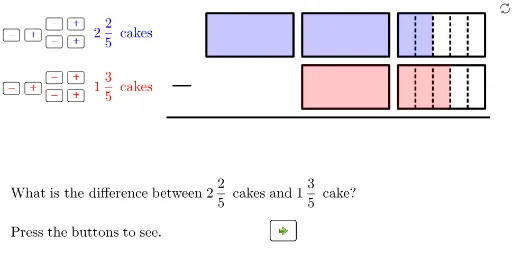
This example demonstrates the process of subtracting fractions with the same denominator. It involves core mathematical concepts such as fraction subtraction, fraction operation rules, and fraction representation. The construction utilizes GeoGebra commands like If, Point, Vector, Polygon, Sequence, Translate, and Segment to visually represent fractions and the subtraction operation. It is suitable for middle school mathematics education, helping students intuitively understand the calculation method and geometric meaning of fraction subtraction.
GeoGebra Commands & Parameters
If(c > b, m - n - 1, m - n) → ansinteger'If(c > b, (a + b - c) / a, (b - c) / a) → ansfraction'Point(yAxis) → CPoint(yAxis) → BVector((0, 0), (-2.2, 0)) → uPoint(yAxis) → APolygon({A, A + (2, 0), A + (2, 1), A + (0, 1)}) → q1Polygon({B, B + (2, 0), B + (2, 1), B + (0, 1)}) → q2Sequence(Translate[q1, Vector[(i * u)]], i, 1, m) → L_1Sequence(Translate[q2, Vector[(i * u)]], i, 1, n) → L_2Polygon({A, A + ((2 * b / a), 0), A + ((2 * b / a), 1), A + (0, 1)}) → q3Sequence(Translate[q1, Vector[(i * u)]], i, 1, m) → L_5Polygon({B, B + ((2 * c / a), 0), B + ((2 * c / a), 1), B + (0, 1)}) → q4Sequence(Translate[q2, Vector[(i * u)]], i, 1, n) → L_6Sequence(Segment[A + ((i * 2 / a), 0), A + ((i * 2 / a), 1)], i, 1, a - 1) → L_3Sequence(Segment[B + ((i * 2 / a), 0), B + ((i * 2 / a), 1)], i, 1, a - 1) → L_4Polygon({C, C + (2, 0), C + (2, 1), C + (0, 1)}) → q5Translate(C, Vector[(m * u)]) → C'Sequence(Segment[C + ((i * 2 / a), 0), C + ((i * 2 / a), 1)], i, 1, a - 1) → L_{18}Segment(H, I) → fIf(b ≤ c, m - 1, m) → nmaxIf(n < m, a - 1, b - 1) → cmaxSequence(A1 + (i * v) + ((-0.5 * 2 / a), 0.5), i, 0, If[c > b, Min[t2, b] - 1, t2 - 1]) → L_9Sequence(Segment[J + ((i * 2 / a), 1 - t1), J + ((i * 2 / a), 1)], i, 1, a - 1) → L_7Sequence(B1 + (i * v) + ((-0.5 * 2 / a), 0.5), i, 0, t2' - 1) → L_8Sequence(A1 + (i * v) + ((-0.5 * 2 / a), 0.5) + (If[c > b ∧ i > b - 1, -0.2, 0], 0), i, 0, t2' - 1) → L_{10}Sequence(L + (1, 0.5) - (i * u), i, 0, n - 1) → L_{11}Sequence(K + (1, 0.5) - (i * u), i, 0, n - 1) → L_{12}Translate(J, Vector[(t4 * Vector[J, C])]) → J'Polygon({J', J' + (((a + b - c) * 2 / a), 0), J' + (((a + b - c) * 2 / a), 1), J' + (0, 1)}) → q6Sequence(Segment[J' + ((i * 2 / a), 0), J' + ((i * 2 / a), 1)], i, 0, a + b - c) → L_{13}Sequence(Segment[J' + (0, i), J' + (((a + b - c) * 2 / a), i)], i, 0, 1) → L_{14}Translate(K, Vector[(t4 * Vector[K, E])]) → K'Polygon({K', K' + (2, 0), K' + (2, 1), K' + (0, 1)}) → q7Polygon({K', K' + (2, 0), K' + (2, 1), K' + (0, 1)}) → q8Translate(A, Vector[(t4 * Vector[A, C])]) → A'Polygon({A', A' + (((b - c) * 2 / a), 0), A' + (((b - c) * 2 / a), 1), A' + (0, 1)}) → q9Sequence(Segment[A' + ((i * 2 / a), 0), A' + ((i * 2 / a), 1)], i, 0, b - c) → L_{15}Sequence(Segment[A' + (0, i), A' + (((b - c) * 2 / a), i)], i, 0, 1) → L_{16}Sequence(Polygon[{A' + (i * u), A' + (i * u) + (2, 0), A' + (i * u) + (2, 1), A' + (i * u) + (0, 1)}], i, 1, m - n) → L_{17}Sequence(Polygon[{A' + (i * u), A' + (i * u) + (2, 0), A' + (i * u) + (2, 1), A' + (i * u) + (0, 1)}], i, 1, m - n) → L_{19}If(c > b, 1, 0) → s1If(b > 0 ∨ c > 0, 1, 0) → s2If(n > 0, 1, 0) → s3If(t1 + t2 + t3 + t4 ≥ s1 + s2 + s3 + s4, true, false) → finishedSequence({Segment[B1 + (i * v), B1 + ((i + 1) * v) + (0, 1)], Segment[B1 + (i * v) + (0, 1), B1 + ((i + 1) * v)]}, i, 0, t2' - 1) → L_8'Sequence({Segment[A1 + (i * v) + (If[c > b ∧ i > b - 1, -0.2, 0], 0), A1 + ((i + 1) * v) + (If[c > b ∧ i > b - 1, -0.2, 0], 1)], Segment[A1 + (i * v) + (If[c > b ∧ i > b - 1, -0.2, 0], 1), A1 + ((i + 1) * v) + (If[c > b ∧ i > b - 1, -0.2, 0], 0)]}, i, 0, t2' - 1) → L_{10}'Sequence({Segment[L - (i * u), L - (i * u) + (2, 1)], Segment[L - (i * u) + (0, 1), L - (i * u) + (2, 0)]}, i, 0, n - 1) → L_{11}'Sequence({Segment[K - (i * u), K - (i * u) + (2, 1)], Segment[K - (i * u) + (0, 1), K - (i * u) + (2, 0)]}, i, 0, n - 1) → L_{12}'
AI Drawing Prompt Reference
Create a visual demonstration of fraction subtraction with the same denominator. Include two rectangular bars to represent the minuend and subtrahend, showing the subtraction process through movement and overlap. Use points and line segments to highlight key positions and the result of the operation, clearly illustrating the geometric meaning of fraction subtraction.
The prompt above was compiled from the original drawing commands and is for reference only.