
Stratified, Systematic, Cluster, and Simple Random Sampling
Loading the math board and drawing, please wait…
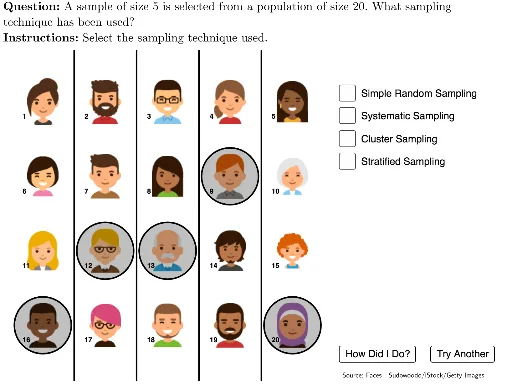
This example illustrates four common sampling methods: stratified sampling, systematic sampling, cluster sampling, and simple random sampling. Students can understand how to draw samples from a population for statistical analysis. Mainly using GeoGebra commands such as Flatten, Random, Element, RandomElement, Zip, and Sequence. Suitable for high school statistics courses.
GeoGebra Commands & Parameters
Flatten(Sequence[Sequence[(i, j), i, 0, 22, 5.475], j, 9.5, -11, -6.55]) → peopleCentersRandom(1, 4) → samplingTechniqueLaTeX((((("\text{" * QUESTION) * "\\") * INSTRUCTIONS) * "}")) → TEXTElement(allTheOptions, samplingTechnique) → optionsForChosenTechniqueRandomElement(optionsForChosenTechnique) → chosenSampleZip(Circle[Element[peopleCenters, A], 2.5], A, chosenSample) → circlesLaTeX(UnicodeToLetter[10003]) → cmarkSequence(Segment[(i, 14), (i, -15)], i, 2.75, 20, 5.475) → stratifiedLinesLaTeX(UnicodeToLetter[10007]) → xmarkLaTeX("\text{The population is divided\\into groups and a member is\\chosen from each group. This\\is an example of Stratified\\Sampling.}") → feedbackStratifiedSamplingLaTeX("\text{Starting with the first selected\\member, every \(4\)th member\\has been chosen. This is an\\example of Systematic\\Sampling.}") → feedbackSystematicSamplingLaTeX("\text{The population is divided into\\groups and an entire group is\\chosen. This is an example of\\Cluster Sampling.}") → feedbackClusterSamplingLaTeX("\text{Members have been chosen\\randomly from the population.\\This is an example of Simple\\Random Sampling.}") → feedbackSimpleRandomSamplingLaTeX("\text{Source: Faces - Sudowoodo/iStock/Getty Images}") → copyrightZip(Text[A, B + (-1.8, -1.5)], A, 1…20, B, peopleCenters) → peopleNumbersSequence(Segment[(-3, j), (25, j)], j, -6.8, 6.2, 6.5) → clusterLines