
Estimate the Value of π Using Probability - Monte Carlo Method
Loading the math board and drawing, please wait…
In collections
Pi Approximations
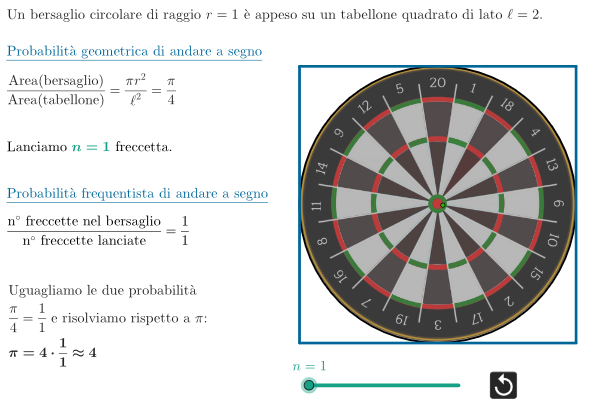
This example estimates the value of pi by simulating random points falling within a unit circle. It involves core concepts of probability and coordinate geometry. Commands used include Polygon, Sequence, KeepIf, Length, and Midpoint. Suitable for high school math education and students learning probability and statistics.
GeoGebra Commands & Parameters
Polygon(A, B, 4) → quadrato, f, g, h, i, C, DSequence(RandomPointIn[quadrato], k, 1, quanteFrecc) → allPts, {(0.03741627389361346, -0.003943707706020927)}KeepIf(IsInRegion[P, bersaglio], P, allPts) → allPtsInCircleLength(allPtsInCircle) → countInMidpoint(A, C) → KKeepIf(¬IsInRegion[P, bersaglio], P, allPts) → allPtsOutsideCircle
AI Drawing Prompt Reference
Draw a unit circle and some random points. The distribution of points inside and outside the circle can be used to estimate π. The relationship between the circle's boundary and the points can be shown through a geometric figure.
The prompt above was compiled from the original drawing commands and is for reference only.