
SSS Triangle Congruence: Dynamic Proof and Visualization
Loading the math board and drawing, please wait…
In collections
Congruence (CO) Cluster
Congruence (Vol 1)
Congruence (Vol 1) Over 80 Resources
Geometry (Congruence) Volume 1
CCSS High School: Geometry (Congruence) Volume 1 S N ATTAR
CCSS High School: Geometry (Congruence) Volume 1
CCSS High School: Geometry (Congruence) Volume 1
CCSS High School: Geometry (Congruence) Volume 1
CCSS High School: Geometry (Congruence) Volume 1
CCSS High School: Geometry (Congruence) Volume 1
CCSS High School: Geometry (Congruence) Volume 1
CCSS High School: Geometry (Congruence) Volume 1
CCSS High School: Geometry (Congruence) Volume 1
CCSS High School: Geometry (Congruence) Volume 1
CCSS High School: Geometry (Congruence) Volume 1
CCSS High School: Geometry (Congruence) Volume 1
Triangle Theorems
CCSS High School: Geometry (Congruence) Volume 1
Unit 5: Triangle Congruence
Triangle Congruence Theorems 1
Triangle Congruence Book 1
Proving Triangles Congruent
Triangle Congruence
Triangle Congruence
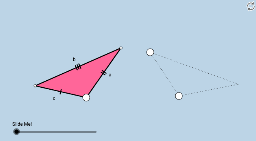
① This example dynamically illustrates the SSS (Side-Side-Side) triangle congruence theorem: if three corresponding sides of two triangles are equal, the triangles are congruent. ② The core mathematical concept is the SSS congruence criterion, involving geometric transformations such as translation, rotation, and reflection, and the invariance of side lengths under these transformations. ③ Construction highlights: using GeoGebra commands including Circle, Intersect, Segment, Polygon, Point, Line, Angle, Dilate, Vector, Translate, Rotate, Mirror, and Ray, the applet constructs a triangle and its dynamic copy, allowing users to drag vertices and observe that the triangles remain congruent. ④ Suitable for middle school geometry (grades 8-9) to teach congruence theorems, and useful for classroom demonstrations or student self-exploration to intuitively grasp the sufficiency of the SSS condition.
GeoGebra Commands & Parameters
Circle(A, a) → dIntersect(d, e) → B, CCircle(C, b) → fSegment(A, C) → gCircle(A, c) → kIntersect(k, f) → F, G, ,Segment(C, F) → hSegment(F, A) → iPolygon(A, C, F) → poly1, f_1, a_1, c_1Circle(D, i) → pPoint(p) → ESegment(D, E) → nCircle(D, g) → qCircle(E, h) → rIntersect(q, r, 2) → HSegment(D, H) → sSegment(H, E) → tLine(A, n) → g_1Point(g_1) → IAngle(I, A, F) → αDilate(A, If[0 < o ≤ 1, 1 - o, 0], D) → A'Vector(A, A') → uTranslate(F, u) → F'Translate(A, u) → A'_1Segment(F', A'_1) → i'Rotate(F', If[1 < o ≤ 2, ((-(o - 1)) * α), (-α)], D) → F''Rotate(A'_1, If[1 < o ≤ 2, ((-(o - 1)) * α), (-α)], D) → JSegment(F'', J) → i''Dilate(A, If[2 < o ≤ 3, 3 - o, 0], D) → A'_2Vector(A, A'_2) → vTranslate(A, v) → A'_3Translate(C, v) → C'Segment(A'_3, C') → g'Line(D, g) → h_1Point(h_1) → KAngle(H, D, K) → βRotate(A'_3, If[3 < o ≤ 4, ((-(o - 3)) * β), (-β)], D) → LRotate(C', If[3 < o ≤ 4, ((-(o - 3)) * β), (-β)], D) → C''Segment(L, C'') → g''Line(C, t) → i_1Point(i_1) → MAngle(M, C, F) → γDilate(C, If[4 < o ≤ 5, 5 - o, 0], C'') → C'_1Vector(C, C'_1) → wTranslate(C, w) → C'_2Translate(F, w) → F'_1Segment(C'_2, F'_1) → h'Rotate(C'_2, If[5 < o ≤ 6, ((-(o - 5)) * γ), (-γ)], C'') → NRotate(F'_1, If[5 < o ≤ 6, ((-(o - 5)) * γ), (-γ)], C'') → OSegment(N, O) → h''Polygon(D, C'', E) → poly2, e_1, d_1, c''Dilate(A, If[(6 * 0.5) < o ≤ 7.5, 7.5 - o, 0], D) → A'_4Vector(A, A'_4) → u_1Translate(A, u_1) → A'_5Translate(C, u_1) → C'_3Translate(F, u_1) → F'_2Polygon(A'_5, C'_3, F'_2) → poly1', f'_2, a'_5, c'_3Rotate(A'_5, If[7.5 < o ≤ 8.5, ((-(o - 7.5)) * γ), (-γ)], D) → PRotate(C'_3, If[7.5 < o ≤ 8.5, ((-(o - 7.5)) * γ), (-γ)], D) → QRotate(F'_2, If[7.5 < o ≤ 8.5, ((-(o - 7.5)) * γ), (-γ)], D) → RPolygon(P, Q, R) → poly1'', r_1, p_1, q_1Line(F, C) → j_1Mirror(A, j_1) → A'_6Mirror(C, j_1) → C'_4Mirror(F, j_1) → F'_3Polygon(A'_6, C'_4, F'_3) → poly1'_1, f'_3, a'_6, c'_4Point(j_1) → SPoint(j_1) → TRay(C'_4, T) → k_1Ray(F'_3, S) → l_1Segment(A'_6, F'_3) → m_1Segment(A'_6, C'_4) → n_1
AI Drawing Prompt Reference
Draw a triangle ABC, then create a dynamic triangle A'B'C' by translating, rotating, and reflecting triangle ABC around point A, while keeping the two triangles congruent. First, draw triangle ABC, then generate triangle A'B'C' through translation and rotation, and observe that they remain congruent.
The prompt above was compiled from the original drawing commands and is for reference only.