
Spherical Coordinates by Lenore Horner
Loading the math board and drawing, please wait…
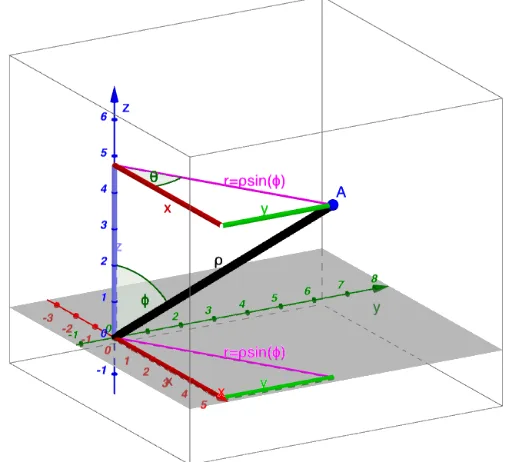
This example demonstrates the spherical coordinate system, which describes points in 3D space using distance, polar angle, and azimuthal angle. Using GeoGebra commands like Segment, Angle, and Translate, it visually shows how points in the spherical coordinate system move and transform. Suitable for high school and above students to learn about coordinate transformations and geometric constructions in 3D space.
GeoGebra Commands & Parameters
Segment((0, 0, 0), A) → ρAngle(A, B, C) → ϕSegment(B, C) → aSegment(C, A) → bTranslate(C, Vector[(-Vector[C])]) → C'Translate(A, Vector[(-Vector[C])]) → A'Segment(C', A') → b'Angle(D, C, A) → θSegment(C, D) → cSegment(D, A) → dSegment(B, (x(A), 0, 0)) → fSegment((x(A), 0, 0), (x(A), y(A), 0)) → g
AI Drawing Prompt Reference
Draw a 3D shape to demonstrate the spherical coordinate system, starting with a line segment from the origin for distance, and adding two more segments for polar and azimuthal angles. Use rotations and translations to show transformations of points in spherical coordinates, including several helper line segments and angle markings to illustrate coordinate transformations and geometric constructions.
The prompt above was compiled from the original drawing commands and is for reference only.