
Sorting Multiples of Integers
Loading the math board and drawing, please wait…
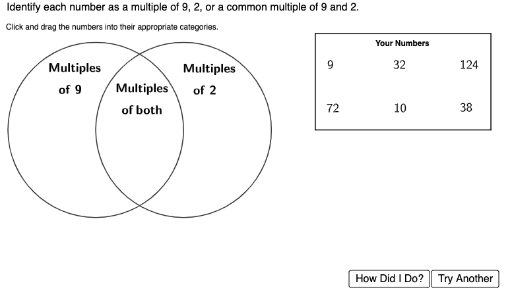
This example demonstrates the sorting and classification of multiples of integers. Key math concepts include integers, multiples, linear equations, and sequences. Construction highlights involve GeoGebra commands like Random, LaTeX, Shuffle, Circle, Segment, and objects such as LeftCircle, RightCircle, ShadeMiddle, etc. Suitable for middle school and above, helping students understand relationships between multiples and sorting algorithms.
GeoGebra Commands & Parameters
Random(2, 12) → MainNum1Random(2, 12) → MainNum2LaTeX(Text[Rand1]) → TextRand1LaTeX(Text[Rand2]) → TextRand2LaTeX(Text[Rand3]) → TextRand3LaTeX(Text[Rand4]) → TextRand4LaTeX(Text[Rand5]) → TextRand5LaTeX(Text[Rand6]) → TextRand6Shuffle(ListOfPoints) → ShuffledListOfPoints, {(7.5, 3.5), (9, 3.5), (7.5, 2.5), (9, 2.5), (10.5, 3.5), (10.5, 2.5)}Circle(Point1, 0.25) → DragArea1Circle(Point2, 0.25) → DragArea2Circle(Point3, 0.25) → DragArea3Circle(Point4, 0.25) → DragArea4Circle(Point5, 0.25) → DragArea5Circle(Point6, 0.25) → DragArea6LaTeX(Text["\checkmark"]) → RightCheckLaTeX(Text["×"]) → WrongCheckLaTeX(Text[("Multiples\\\,\\\,\,\,\,\,of\,\," * MainNum1)]) → TextLeftCircleLaTeX(Text[("Multiples\\\,\\\,\,\,\,\,of\,\," * MainNum2)]) → TextRightCircleSegment(A, B) → fSegment(C, D) → gSegment(D, A) → hSegment(C, B) → iRandom(2, 12) → MainNum2_1LaTeX(Text["Multiples\\\,\\\,\,\,of\,both"]) → TextMiddleCircle