
Jupiter-Saturn Trigonometry Demo
Loading the math board and drawing, please wait…
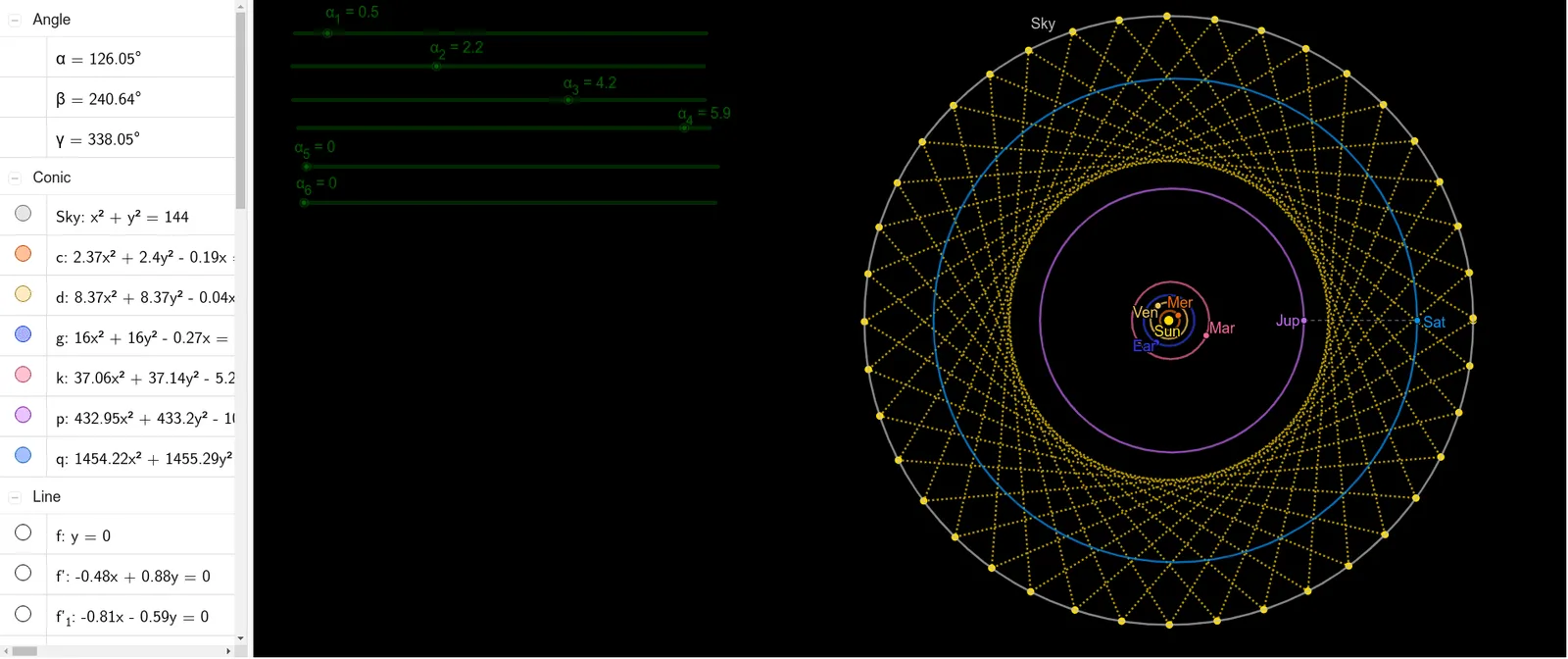
This example demonstrates the trigonometric relationship between Jupiter and Saturn and their trajectories. It involves core mathematical concepts like ellipses, complex numbers, linear programming, function graphs, correlation, and centroids. Construction highlights include commands like Circle, Line, Ellipse, Rotate, Angle, Intersect, Segment, Sequence, Flatten, and PolyLine. Suitable for high school and above students to explore the intersection of celestial mechanics and mathematical modeling.
GeoGebra Commands & Parameters
Circle(Sun, 12) → SkyLine(Sun, xAxis) → fEllipse(Sun, ((0.20563069 * 0.38709893), 0), 0.38709893) → cRotate(f, α_1) → f'Ellipse(Sun, ((0.72333199 * 0.00677323), 0), 0.72333199) → dEllipse(Sun, ((1.00000011 * 0.01671022), 0), 1.00000011) → gEllipse(Sun, ((1.52366231 * 0.09341233), 0), 1.52366231) → kEllipse(Sun, ((5.20336301 * 0.04839266), 0), 5.20336301) → pEllipse(Sun, ((9.53707032 * 0.0541506), 0), 9.53707032) → qAngle(α_2) → αRotate(f, α_2) → f'_1Intersect(d, f'_1, 2) → VenAngle(α_3) → βRotate(f, α_3) → f'_2Angle(α_4) → γRotate(f, α_4) → f'_3Intersect(k, f'_3, 2) → MarIntersect(g, f'_2, 2) → EarIntersect(c, f', 2) → MerRotate(f, α_5) → f'_4Intersect(p, f'_4, 2) → JupRotate(f, α_6) → f'_5Intersect(q, f'_5, 2) → SatSegment(Jup, Sat) → hSequence(Mod[((diff * 360 / Jup_p) * j), 360], j, 1, 40, 1) → l1Intersect(Sky, f, 2) → ASequence(Mod[(((diff * 2) * π / Jup_p) * j), (2 * π)], j, 1, Length[l1], 1) → l2Sequence(Rotate[A, l2(j)], j, 1, Length[l1], 1) → l3Flatten({A, l3}) → l4PolyLine(l4) → i
AI Drawing Prompt Reference
Draw elliptical orbits centered at the Sun for Jupiter, Saturn, Mercury, Venus, Mars, and Earth. Use rotation and translation commands based on their orbital periods and eccentricities to generate the orbital lines for Jupiter and Saturn, then find their intersections with their respective orbital lines to determine their positions. Finally, generate the line connecting Jupiter and Saturn through rotation and intersection calculations, and draw the relative positions of Jupiter and Saturn over time.
The prompt above was compiled from the original drawing commands and is for reference only.