
Hyperbolic and Complex Angle Visualization
Loading the math board and drawing, please wait…
In collections
complex-numbers
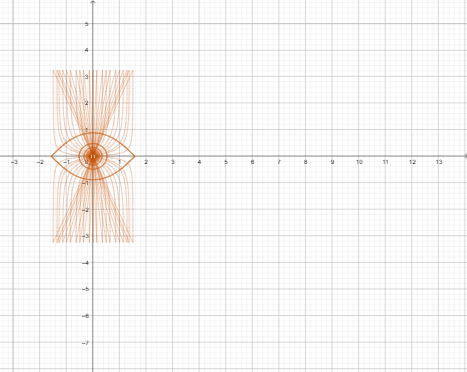
This example demonstrates the combination of a hyperbolic angle (x+y)=(x^2-y^2)*e^t and a complex angle (x+yi)=(x^2+y^2)*e^(mi) to create a unique shape. Key mathematical concepts include hyperbolic functions, complex numbers, and exponential functions. The Surface command is used to draw the shape. Suitable for high school math education and learning about complex numbers and hyperbolic functions.
GeoGebra Commands & Parameters
Surface((ί * ln((u^(-1) * ℯ^((((-(1 / 2)) * ί) * v))) - sqrt((u^(-2) * ℯ^((-((ί * v))))) - 1))), u, -10, 10, v, -10, 10) → eSurface((ί * ln((u^(-1) * ℯ^((((-(1 / 2)) * ί) * v))) + sqrt((u^(-2) * ℯ^((-((ί * v))))) - 1))), u, -10, 10, v, -10, 10) → fSurface((ί * ln((u^(-1) * ℯ^((((-(1 / 2)) * ί) * v))) + sqrt((u^(-2) * ℯ^((-((ί * v))))) + 1))), u, -10, 10, v, -10, 10) → gSurface((ί * ln((u^(-1) * ℯ^((((-(1 / 2)) * ί) * v))) - sqrt((u^(-2) * ℯ^((-((ί * v))))) + 1))), u, -10, 10, v, -10, 10) → a
AI Drawing Prompt Reference
Create a 3D shape composed of four surfaces, each defined by parameters u and v ranging from -10 to 10. The surfaces involve exponential functions and square roots, forming complex wave-like or spiral structures. The four surfaces differ by sign combinations (plus/minus) in their formulas, together enclosing a symmetric, rotationally symmetric volume. The shape should show smooth transitions between surfaces, illustrating the combination of hyperbolic and complex exponential functions, suitable for educational visualization.
The prompt above was compiled from the original drawing commands and is for reference only.