
Solving Quadratic Equations with Formula
Loading the math board and drawing, please wait…
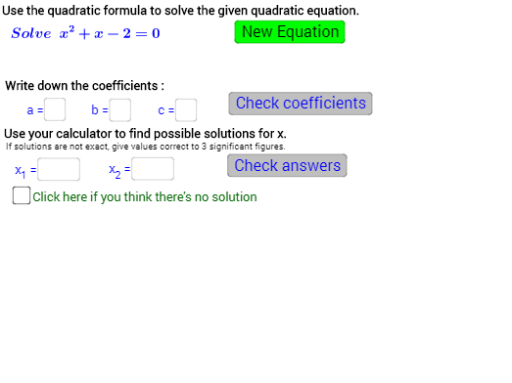
This example demonstrates solving quadratic equations using the formula. Key mathematical concepts include the roots of a quadratic equation, discriminant, and the quadratic formula. Using GeoGebra commands like Sequence, Union, and Simplify, the roots of the quadratic equation are constructed. Suitable for middle school and above students to learn how to solve quadratic equations.
GeoGebra Commands & Parameters
Sequence(i, i, -20, 20, 1) → list3Sequence(i, i, 1, 20, 1) → list4Sequence(i, i, -20, -1, 1) → list1Union(list1, list4) → list5Sequence(i, i, -13, 15, 1) → list2Simplify((a * x^(2)) + (b * x) + c) → fRoot(f) → A, BTextfield(inputa) → InputBox1Textfield(inputb) → InputBox2Textfield(inputc) → InputBox3Textfield(inputx1) → InputBox4Textfield(inputx2) → InputBox5Roots(f, -100, 100) → C, DExtremum(f, -30, 30) → EIf(usera ≟ a, true, false) → correctaIf(userb ≟ b, true, false) → correctbIf(userc ≟ c, true, false) → correctcIf(y(E) < 0, y(E) + Min[(-abs((0.25 * y(E)))), -5], Min[-5, (-abs((0.25 * y(E))))]) → yMinView2If(y(E) > 0, y(E) + Max[(0.25 * y(E)), 5], Max[abs((0.25 * y(E))), 5]) → yMaxView2Intersect(f, xAxis) → F, GIf(abs(x(C) - Min[userx1, userx2]) < 0.015, true, false) → correctxminIf(abs(x(D) - Max[userx1, userx2]) < 0.01, true, false) → correctxmaxIf(If[discriminant < 0, x(E) + 5, If[discriminant ≟ 0, x(E) + 5, x(G) + (0.5 * abs(x(G) - x(F)))]] < 0, 1, If[discriminant < 0, x(E) + 5, If[discriminant ≟ 0, x(E) + 5, x(G) + (0.5 * abs(x(G) - x(F)))]]) → xMaxView2If(If[discriminant < 0, x(E) - 5, If[discriminant ≟ 0, x(E) - 5, x(F) - (0.5 * abs(x(G) - x(F)))]] > 0, -1, If[discriminant < 0, x(E) - 5, If[discriminant ≟ 0, x(E) - 5, x(F) - (0.5 * abs(x(G) - x(F)))]]) → xMinView2Expand(((x + RandomElement[{-1, 1, -2, 2, -3, 3, -4, 4, -5, 5}]) * (x + RandomElement[{-1, 1, -2, 2, -3, 3, -4, 4, -5, 5}]))) → f_{l1}Text(("x = " * x(C))) → textrootCText(("x = " * x(D))) → textrootD