
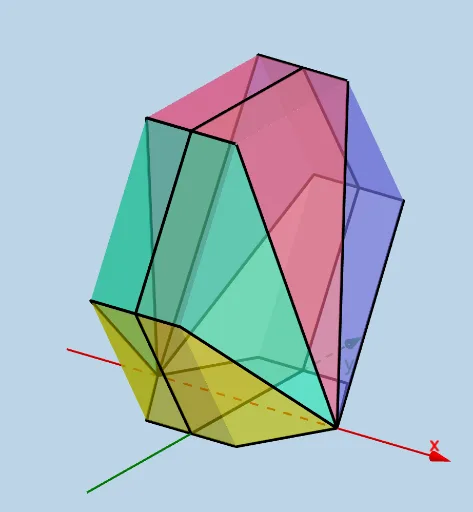
Solid with Regular Hexagonal Base: Cross Sections Parallel to yAxis are also Reg
Loading the math board and drawing, please wait…
This example demonstrates a solid with a regular hexagonal base where cross-sections parallel to the yAxis are also regular hexagons. Core math concepts include solid geometry, polygon properties, and integral calculus. Construction highlights involve commands like Segment, Midpoint, Intersect, Line, Sphere, Rotate, Polygon, and more from GeoGebra, suitable for high school and above learning spatial geometry and integral applications.
GeoGebra Commands & Parameters
Segment(H, I) → s_1Midpoint(s_1) → A_1Segment(J, K) → q_1Midpoint(q_1) → ZMidpoint(s_1) → EMidpoint(q_1) → FIntersect(upper, h, (0, 8.66025)) → BIntersect(lower, h, (0, -8.66025)) → CSegment(C, B) → qIntersect(upper, q, (0, 8.66025)) → GMidpoint(C, G) → TLine(B, D) → iSphere(B, d) → eSegment(C, B) → pTextfield(upper) → InputBox1Textfield(lower) → InputBox2Textfield(a) → InputBox3Textfield(b) → InputBox4Segment(C, G) → k_1Line(C, G) → jSphere(G, T) → kLine(T, T + (1, 0, 0)) → mRotate(G, π / 3, F_1, m) → G'Rotate(G', π / 3, F_1, Line[F_1, F_1 + (1, 0, 0)]) → G''Line(F_1, F_1 + (1, 0, 0)) → nRotate(G'', π / 3, F_1, n) → G'''Rotate(G''', π / 3, F_1, n) → G_1Polygon(C, G, G', G'', G''', G_1) → poly1, c_1, g_2, g', g'', g''', g_3Segment(G', G'') → lSegment(G'', G''') → rSegment(G''', G_1) → sSegment(G_1, C) → tSegment(G', G) → i_1Line(Z, Z + (1, 0, 0)) → fLine(D_1, D_1 + (1, 0, 0)) → gRotate(J, π / 3, D_1, g) → J'Rotate(J', π / 3, D_1, g) → J''Rotate(J'', π / 3, D_1, g) → J'''Rotate(J''', π / 3, D_1, g) → E_1Segment(J, J') → f_1Segment(J', J'') → g_1Segment(J'', J''') → j_1Segment(J''', E_1) → n_1Segment(E_1, K) → p_1Line(H_1, H_1 - (1, 0, 0)) → l_1Rotate(I, π / 3, H_1, l_1) → I'Rotate(I', π / 3, H_1, l_1) → I''Rotate(I'', π / 3, H_1, l_1) → I'''Rotate(I''', π / 3, H_1, l_1) → I_1Segment(I, I') → m_1Segment(I', I'') → r_1Segment(I'', I''') → a_1Segment(I''', I_1) → b_1Segment(I_1, H) → d_1Polygon(H, I, I', I'', I''', I_1) → poly2, h_2, i_2, i', i'', i''', i_3Polygon(K, J, J', J'', J''', E_1) → poly3, k_2, j_2, j', j'', j''', e_1CurveCartesian(t, (0.5 * (lower(t) + upper(t))) - (upper(t) - lower(t)), (((-sqrt(3))) / 2 * (lower(t) - upper(t))), t, a, b) → vCurveCartesian(t, lower(t), ((-sqrt(3)) * (lower(t) - upper(t))), t, a, b) → cCurveCartesian(t, upper(t), ((-sqrt(3)) * (lower(t) - upper(t))), t, a, b) → wCurveCartesian(t, (0.5 * (lower(t) + upper(t))) + upper(t) - lower(t), (((-sqrt(3))) / 2 * (lower(t) - upper(t))), t, a, b) → o_1Surface(u, lower(u) + ((-v) * (upper(u) - lower(u)) / 2), ((v * sqrt(3)) * (upper(u) - lower(u)) / 2), u, a, b, v, 0, 1) → oSurface(u, lower(u) - (0.5 * (upper(u) - lower(u))) + ((v * 0.5) * (upper(u) - lower(u))), (sqrt(3) / 2 * (upper(u) - lower(u))) + ((v * sqrt(3) / 2) * (upper(u) - lower(u))), u, a, b, v, 0, 1) → uSurface(u, lower(u) + (v * (upper(u) - lower(u))), (sqrt(3) * (upper(u) - lower(u))), u, a, b, v, 0, 1) → u_1Surface(u, upper(u) + (0.5 * (upper(u) - lower(u))) + (((-v) * 0.5) * (upper(u) - lower(u))), (sqrt(3) / 2 * (upper(u) - lower(u))) + ((v * sqrt(3) / 2) * (upper(u) - lower(u))), u, a, b, v, 0, 1) → v_1Surface(u, upper(u) + (v * (upper(u) - lower(u)) / 2), ((v * sqrt(3)) * (upper(u) - lower(u)) / 2), u, a, b, v, 0, 1) → w_1