
Napoleon’s Theorem Check: Constructing Equilateral Triangles and Area Relations
Loading the math board and drawing, please wait…
In collections
Besondere Punkte/Special Points
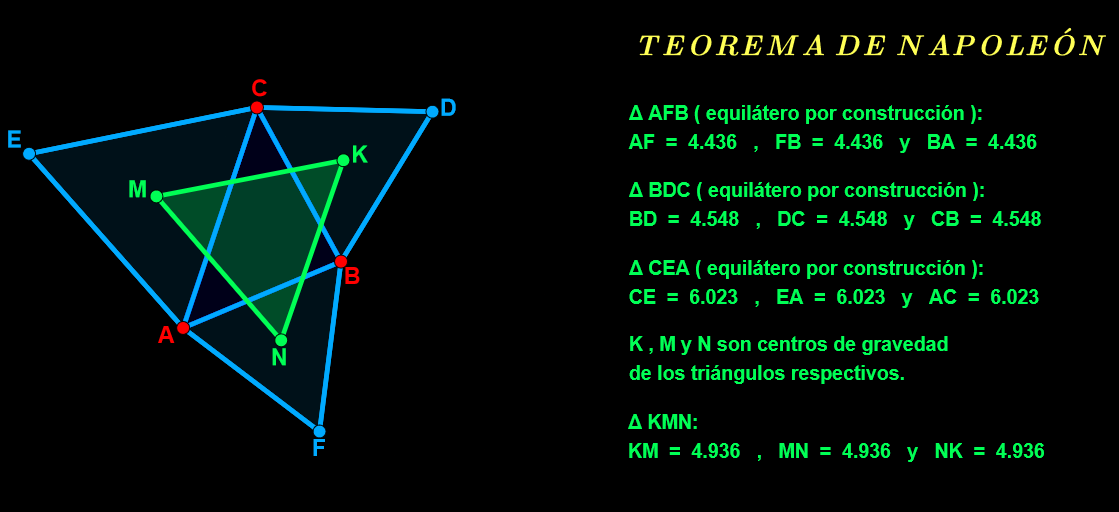
This example demonstrates the geometric phenomenon behind Napoleon’s Theorem: for a given triangle, equilateral triangles are constructed externally (or consistently), and the configuration’s resulting area/sum relationships are verified through computed subareas. Key concepts include Napoleon’s Theorem, equilateral-triangle construction, area decomposition and summation (with an intuitive link to definite-integral/Riemann-sum thinking), and geometric invariants induced by the construction. In GeoGebra, the build is driven by Polygon to create the base and auxiliary triangles (ΔABC, ΔCBD, ΔACE, ΔBAF, etc.), LineBisector to obtain the required bisector-based auxiliary directions/points, and Intersect to find intersection points that determine new vertices (D, E, F, and related points). The example then computes areas of multiple regions (Sab, Sbc, Sca, Sce, Saf, Sbd, …) and uses text objects (textoA, textoB, textoC, textoD) to display the verification values. Suitable for high school geometry through early university study, especially for theorem visualization and practice with constructive geometry and area relationships.
GeoGebra Commands & Parameters
Polygon(A, B, C) → ΔABC, ab, bc, caPolygon(C, B, 3) → ΔCBD, cb, bd, dc, DPolygon(A, C, 3) → ΔACE, ac, ce, ea, EPolygon(B, A, 3) → ΔBAF, ba, af, fb, FLineBisector(A, B) → SabLineBisector(B, C) → SbcLineBisector(C, A) → ScaLineBisector(C, E) → SceLineBisector(A, F) → SafLineBisector(B, D) → SbdIntersect(Sab, Sbc) → GIntersect(Sbd, Sbc) → KIntersect(Sce, Sca) → MIntersect(Saf, Sab) → NPolygon(N, K, M) → ΔKMN, nk, km, mn
AI Drawing Prompt Reference
Draw an arbitrary triangle. On each of its three sides, construct an equilateral triangle outward, sharing that side with the original triangle. Then, draw the perpendicular bisectors of the original triangle's sides and also of some sides of the equilateral triangles. Use the intersections of these bisectors to determine three new points, and connect these points to form a new triangle. Finally, compute and display the areas of the original triangle, the three equilateral triangles, and the new triangle, to verify the area relationships stated in Napoleon's theorem.
The prompt above was compiled from the original drawing commands and is for reference only.