
Exercise 7 Solution: Constructing intersection geometry and linking with inequal
Loading the math board and drawing, please wait…
In collections
geometriadinamica.es
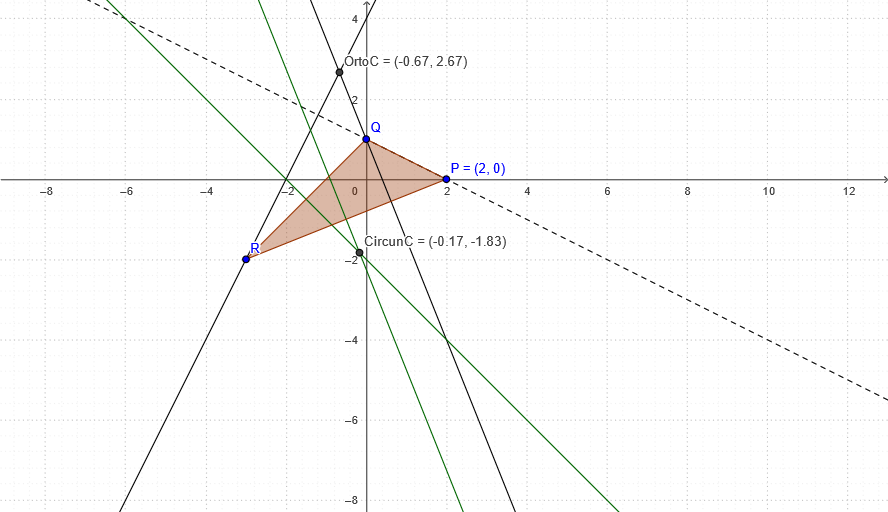
This example demonstrates how to build a solution by constructing key points and geometric quantities from basic operations, then using the resulting constraints in an equation/inequality-style reasoning (including geometric-mean type quantities). The main mathematical ideas include: intersection of lines to determine critical points, angle bisectors to encode equal-angle conditions, orthogonal (perpendicular) constructions to impose right-angle constraints, and area measurements of a polygonal region to connect geometry with algebraic expressions. Construction highlights (from the provided GeoGebra summary): Polygon to form the relevant polygonal region and obtain its Area; Line to create the guiding lines (with points and named elements such as P, Q, R and variables like p, q, r, as reflected in the object list); Intersect to compute intersection points that drive the configuration; OrthogonalLine to construct perpendicular lines linked to helper objects like OrtoC and auxiliary distances/markers (e.g., d, e); and LineBisector to create angle-bisector relationships (corresponding to quantities b, c). The configuration also includes CircunC for a circular constraint/auxiliary construction, tying the geometric framework to the named parameters a, b, c. Suitable for secondary-level geometry construction practice, exam/contest preparation, and classroom demos using GeoGebra.
GeoGebra Commands & Parameters
Polygon(Q, R, P) → Área, p, q, rOrthogonalLine(Q, q) → aLine(Q, P) → bOrthogonalLine(R, b) → cIntersect(a, c) → OrtoCLineBisector(q) → dLineBisector(p) → eIntersect(d, e) → CircunC
AI Drawing Prompt Reference
Draw a triangle with vertices labeled P, Q, and R. From vertex Q, construct a line perpendicular to the opposite side, and from vertex R, construct another perpendicular to a different side. These two perpendicular lines intersect at a point, marking a key intersection. Then, construct the perpendicular bisectors of two sides of the triangle; these bisectors intersect at another point, which serves as the circumcenter. Finally, draw a circle centered at this circumcenter passing through the triangle's vertices. The complete figure includes the triangle, two perpendicular lines, two perpendicular bisectors, two intersection points, and a circumcircle, illustrating the connection between geometric construction and algebraic quantities like area and inequalities.
The prompt above was compiled from the original drawing commands and is for reference only.