
Snub Operation from Cube to Octahedron, Rhombicuboctahedron, and Snub Cube
Loading the math board and drawing, please wait…
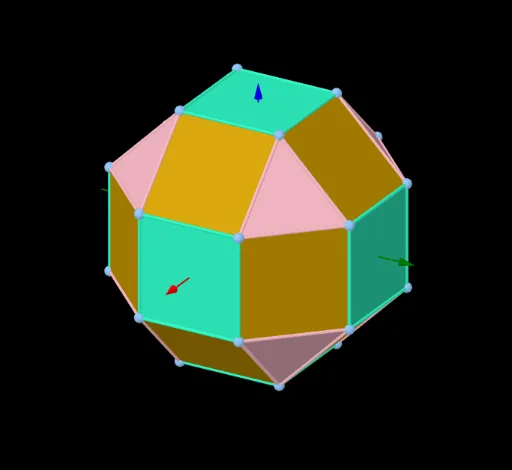
This example demonstrates the snub operation transforming a cube into an octahedron, rhombicuboctahedron, and snub cube. Key mathematical concepts include polyhedral transformations in solid geometry. Using GeoGebra commands such as Zip, Length, Sequence, and Join, the process of generating these polyhedra is visually illustrated. Suitable for high school and university students and educators.
GeoGebra Commands & Parameters
Zip(Vector[(zoom * (Element[a, 1], Element[a, 2], Element[a, 3]))], a, m_octahedron) → V6zoomLength(V6zoom(1)) → rZip(Vector[(zoom * (Element[a, 1], Element[a, 2], Element[a, 3]))], a, m_cube) → V8zoomSequence(Sequence[V8zoom(faces(i, k)), k, 1, Length[faces(1)]], i, 1, Length[faces]) → V8cubeZip(Polygon[a], a, V8cube) → poly_cube0Zip(Sum[a] / 4, a, V8cube) → CmiZip(Rotate[a, β, Line[O, b]], a, V8cube, b, Cmi) → V8'Zip(Dilate[a, q, b] + ((c - b) * t), a, V8', b, Cmi, Vector[c], V6zoom) → V4Join(V4) → lP0Textfield(t) → InputBox1Zip(Polygon[a], a, V4) → poly4Length(lP0) → läA0Length(lP0(1)) → R_A0Sphere((0, 0, 0), R_A0) → aLength(V6zoom(1)) → rA6Zip(Polygon[a], a, V4) → poly4_cube'Sequence(Polygon[Sequence[lP0(m_3(f, k)), k, 1, Length[m_3(1)]]], f, 1, Length[m_3]) → poly3Sequence(Polygon[Sequence[lP0(m3_4(f, k)), k, 1, Length[m3_4(1)]]], f, 1, Length[m3_4]) → poly_{3}'Sequence(Polygon[Sequence[lP0(m_4(f, k)), k, 1, Length[m_4(1)]]], f, 1, Length[m_4]) → poly_{4}Length(Unique[lP0]) → läLength(lP0) → nIf(j, "\fgcolor{orange}{\; ∙---}", "") → txt1If(j, "\fgcolor{#318CE7}{\; ∙---}", "") → txt2If(j, "\fgcolor{magenta}{\; ∙---}", "") → txt3If(j, "\fgcolor{green}{\; ∙---}", "") → txt2aSequence(Segment[lP0(m_3(2, i)), lP0(m_3(2, If[i ≟ 3, 0, i] + 1))], i, 1, 3) → seg3Sequence(Segment[lP0(m_4(2, i)), lP0(m_4(2, If[i ≟ 4, 0, i] + 1))], i, 1, 4) → seg4'Sequence(Segment[V4(1, i), V4(1, If[i ≟ 4, 1, i + 1])], i, 1, 4) → seg4Sequence(Segment[lP0(m3_4(4, i)), lP0(m3_4(4, If[i ≟ 3, 0, i] + 1))], i, 1, 3) → seg3'TableText(Append["segments", 1…4], Append["\fgcolor{#FB607F}{3-gon}" + txt1, seg3], Append["\fgcolor{#B2BEB5}{3-gon'}'" + txt2, seg3'], Append["\fgcolor{Turquoise}{4-gon}" + txt3, seg4], "v") → text2bTextfield(dα) → InputBox2Textfield(dt) → InputBox3TableText(Append["segments", 1…4], Append["\fgcolor{#FB607F}{3-gon}" + txt1, seg3], Append["\fgcolor{#C19A6B}{4'-gon}" + txt2a, seg4], Append["\fgcolor{Turquoise}{4-gon}" + txt3, seg4'], "v") → text2a