
Slider Exercise 2: Combined Midpoint, Rotation and Dilation Transformations
Loading the math board and drawing, please wait…
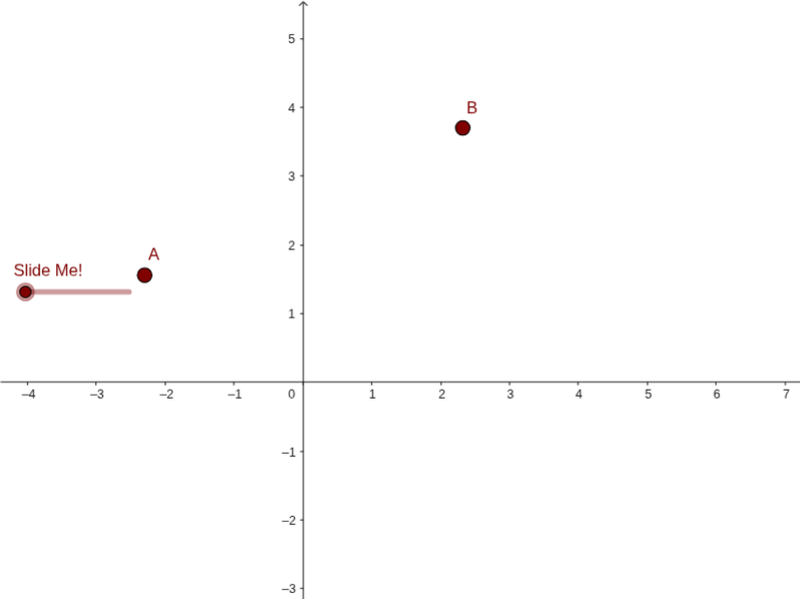
① This example demonstrates dynamic geometric transformations controlled by sliders, combining midpoint, rotation, and dilation (homothety) effects, with connections to hyperbola and logarithmic functions. ② Core mathematical concepts include midpoint, dilation, rotation, median line, hyperbola, logarithm, and stochastic processes, highlighting the interplay between transformation geometry and function graphs. ③ Construction details: GeoGebra commands used are Midpoint, Dilate, Segment, and Rotate; objects include points A, B, C and their transformed images A', C', A'', lines f and g, and function f', all driven by slider a for dynamic variation. ④ Suitable for high school or early college students to understand composition of geometric transformations, parametric dynamic visualization, and to explore how transformations affect function graphs; also useful for teachers creating interactive instructional materials.
GeoGebra Commands & Parameters
Midpoint(A, B) → CDilate(A, If[0 < a ≤ 1, 1 - a, 0], C) → A'Segment(A, A') → fDilate(C, If[1 < a ≤ 2, 2 - a, 0], B) → C'Segment(C, C') → gRotate(A, If[2 < a ≤ 3, ((a - 2) * π), π], C) → A'_1Rotate(A', If[2 < a ≤ 3, ((a - 2) * π), π], C) → A''Segment(A'_1, A'') → f'