
Same Side Interior Angles Theorem (Consecutive Interior Angles Supplementary)
Loading the math board and drawing, please wait…
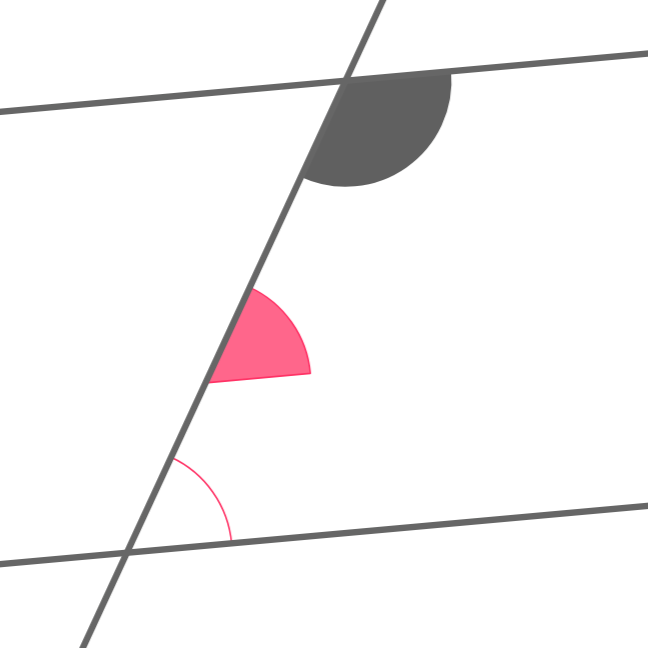
①This GeoGebra example dynamically demonstrates the Same Side Interior Angles Theorem: when two parallel lines are cut by a transversal, the interior angles on the same side of the transversal are supplementary (sum to 180°). ②The core mathematical concept is the parallel-line property of consecutive interior angles, a fundamental theorem in Euclidean geometry. ③Construction highlights: from the construction summary, the example uses commands such as Point, Line, Circle, Intersect, Rotate, Angle, Dilate, Translate, Vector, CircleSector, and CircleArc. Key objects include points A, B, C, lines a, b, c, and angles α and β, with arcs and sectors used to visually emphasize the angle measurescars. The dynamic setup allows users to drag points and observe that α + β remains 180°. ④This is suitable for middle or high school geometry classes, ideal for interactive demonstrations, student exploration of parallel line properties, or as a GeoGebra construction tutorial.
GeoGebra Commands & Parameters
Point(a) → BRotate(B, α, A) → B'Angle(B, A, B') → βLine(A, B') → bCircle(A, 1) → eIntersect(b, d) → CCircle(C, 1) → fIntersect(e, a) → D, EIntersect(e, b) → F, GIntersect(f, b) → H, IIntersect(f, d) → J, KCircleSector(C, K, I) → gCircleSector(C, I, J) → hCircleSector(C, J, H) → kCircleSector(C, H, K) → pCircleSector(A, E, G) → qCircleSector(A, G, D) → rDilate(A, If[0 < i < 1, 1 - i], C) → A'Vector(A, A') → uTranslate(q, u) → q'Translate(r, u) → r'CircleArc(A, E, G) → c_1CircleArc(A, G, D) → f_1