
Alternate Interior Angles Theorem (V1) Dynamic Demo
Loading the math board and drawing, please wait…
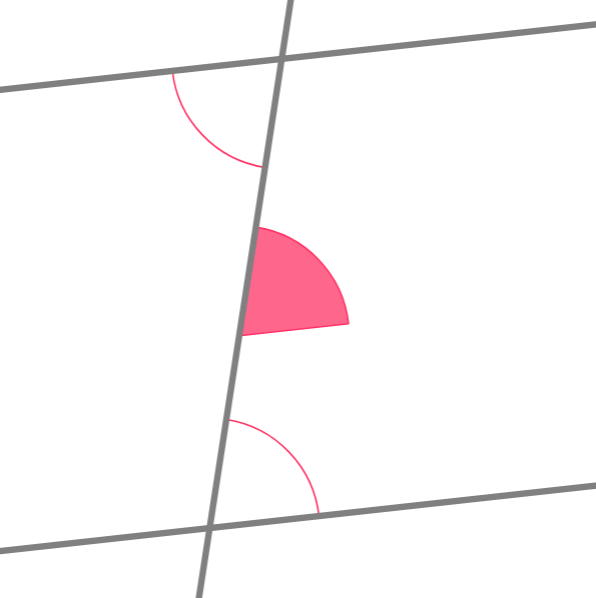
This GeoGebra example dynamically demonstrates the Alternate Interior Angles Theorem: when two parallel lines are cut by a transversal, the alternate interior angles are equal. The core mathematical concepts involve properties of parallel lines, angle relationships, and theorem verification. The construction uses commands such as Point, Line, Circle, Rotate, Angle, Intersect, CircleSector, Dilate, Vector, Translate, and CircleArc to build the parallel lines and transversal, mark and measure the alternate interior angles, and allow dynamic adjustments. Suitable for middle school or high school geometry classes, this interactive tool helps students visualize and verify the theorem by dragging points to change the configuration, reinforcing understanding of angle relationships in parallel line scenarios.
GeoGebra Commands & Parameters
Point(a) → BRotate(B, α, A) → B'Angle(B, A, B') → βLine(A, B') → bCircle(A, 1) → eIntersect(b, d) → CCircle(C, 1) → fIntersect(e, a) → D, EIntersect(e, b) → F, GIntersect(f, b) → H, IIntersect(f, d) → J, KCircleSector(C, J, H) → kCircleSector(C, H, K) → pCircleSector(A, E, G) → qCircleSector(A, G, D) → rCircleSector(A, F, E) → tDilate(A, If[0 < i < 1, 1 - i], C) → A'Vector(A, A') → uTranslate(q, u) → q'Translate(r, u) → r'Translate(t, u) → t'CircleArc(A, E, G) → c_1CircleArc(A, G, D) → f_1CircleArc(C, J, H) → h_1CircleArc(C, H, K) → p_1Vector(A, C) → vTranslate(q, v) → q'_1Rotate(q'_1, (((-(i - 1)) * 180))°, C) → gTranslate(r, v) → r'_1Rotate(r'_1, (((i - 1) * 180))°, C) → h