
Alternate Interior Angles: Quick Investigation with Parallel Lines
Loading the math board and drawing, please wait…
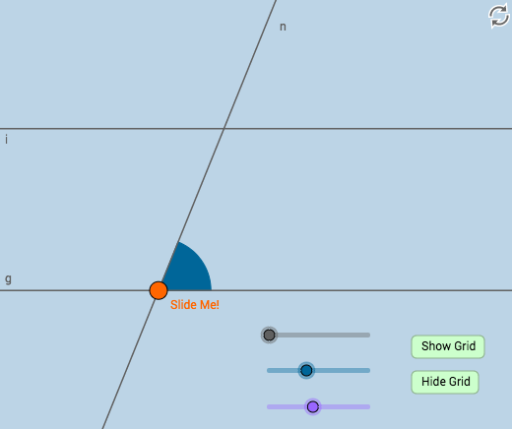
This interactive GeoGebra investigation demonstrates the relationship between alternate interior angles formed when a transversal intersects two parallel lines. The core mathematical concept is the theorem that alternate interior angles are congruent when lines are parallel, along with angle measurement and comparison. Construction highlights include using Point and Line commands to create parallel lines and a transversal; Rotate and Angle commands to generate and label angles (α, β, γ, δ); Intersect, Segment, Circle, and CircleSector to construct intersection points and angle arcs; and Vector, Translate, Ray, and CircleArc for dynamic movement and visual representation. Suitable for middle school geometry, this resource allows students to drag the transversal or lines, observe that alternate interior angles remain equal, and thereby discover and verify the parallel-line angle theorem. Ideal for classroom demonstration, guided inquiry, or independent student exploration.
GeoGebra Commands & Parameters
Point(y = 0) → ALine(A, B) → fRotate(B, α, A) → B'Angle(B, A, B') → γLine(A, B') → gRotate(B', β, A) → B''Angle(B', A, B'') → δLine(A, B'') → hCircle(A, a) → cIntersect(c, h, 2) → CLine(C, g) → iCircle(C, A) → dCircle(A, C) → eIntersect(e, h, 2) → JSegment(A, C) → jCircle(A, (0.3 * j)) → kCircle(C, (0.3 * j)) → pIntersect(p, h) → N, OIntersect(k, h) → P, QIntersect(k, g) → T, UIntersect(p, i, 2) → VIntersect(p, i, 1) → WCircleSector(A, U, Q) → qCircle(C, j / 2) → g_1Circle(A, j / 2) → h_1Intersect(g_1, i, 2) → DIntersect(g_1, i, 1) → EIntersect(g_1, h, 2) → HIntersect(g_1, h) → I, ZIntersect(h_1, h) → A_1, B_1Intersect(h_1, g) → E_1, F_1Point(j) → G_1Vector(A, G_1) → uTranslate(q, u) → q'Segment(A, G_1) → lRay(A, A_1) → mRay(C, H) → nVector(A, G_1) → vSegment(G_1, C) → sCircleArc(A, U, Q) → tCircleArc(C, N, O) → rPoint(r) → FRotate(F, (-δ), C) → F'Angle(F', C, F) → εCircleSector(C, F', F) → c_1Segment(A, C) → b