
Vertical Angles Exploration (2): Interactive Discovery of the Vertical Angles Th
Loading the math board and drawing, please wait…
In collections
Congruence (CO) Cluster
Congruence (Vol 2)
CCSS High School: Geometry (Congruence) Volume 2
CCSS High School: Geometry (Congruence) Volume 2
CCSS High School: Geometry (Congruence) Volume 2
Geometry (Congruence) Volume 2
CCSS High School: Geometry (Congruence) Volume 2
CCSS High School: Geometry (Congruence) Volume 2
CCSS High School: Geometry (Congruence) Volume 2
CCSS High School: Geometry (Congruence) Volume 2
CCSS High School: Geometry (Congruence) Volume 2
CCSS High School: Geometry (Congruence) Volume 2
CCSS High School: Geometry (Congruence) Volume 2
Gail LeBlancCCSS High School: Geometry (Congruence) Volume 2
CCSS High School: Geometry (Congruence) Volume 2
Geometry: Introductory Definitions, Postulates, Theorems
Year 7 (Angles)
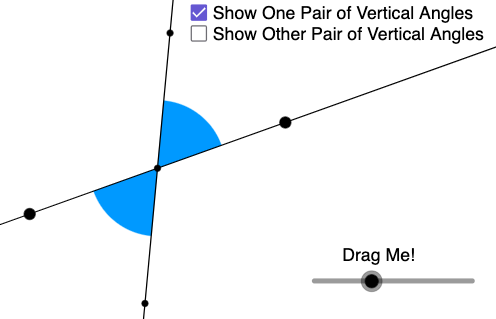
① This interactive GeoGebra example dynamically demonstrates the fundamental geometric fact that vertical angles formed by two intersecting lines are equal. ② The core mathematical concept is the Vertical Angles Theorem, which states that the two pairs of opposite angles created by intersecting lines are congruent, along with angle measurement and comparison. ③ Construction highlights: using GeoGebra commands such as Line, Midpoint, Rotate, Mirror, Segment, Circle, Intersect, CircleSector, and Angle, the applet builds lines, midpoints, rotations, reflections, circles, intersection points, sectors, and angle objects. By dragging vertices or rotating lines, users can observe the real-time changes in angles α, β, γ, and δ to verify the equality of vertical angles. ④ This resource is ideal for middle school geometry lessons or self-study, serving as an inquiry-based exploration of the vertical angles theorem, and is also useful for teachers to demonstrate geometric properties through hands-on manipulation.
GeoGebra Commands & Parameters
Line(A, B) → fMidpoint(A, B) → ORotate(B, (a * pi / 180), O) → CLine(O, C) → gMirror(C, O) → DSegment(O, B) → hSegment(O, A) → iSegment(D, O) → jSegment(O, C) → kCircle(O, (0.5 * h)) → cIntersect(c, f, 2) → EIntersect(c, g, 2) → FIntersect(c, f, 1) → GIntersect(c, g, 1) → HCircleSector(O, E, F) → dCircleSector(O, G, H) → eCircleSector(O, H, E) → pCircleSector(O, F, G) → qAngle(B, O, C) → αAngle(A, O, D) → βAngle(D, O, B) → γAngle(C, O, A) → δ
AI Drawing Prompt Reference
Draw two intersecting lines crossing at a central point, creating four angles. Place a small circle centered at the intersection, which meets the lines at four points. Connect adjacent intersection points with circular arcs to form four sector regions. Label the four angles, and allow one line to rotate about the center, so that as it turns, the angle measures update in real time, while opposite angles remain equal.
The prompt above was compiled from the original drawing commands and is for reference only.