
Solution to Parallel Lines & Angles Problem
Loading the math board and drawing, please wait…
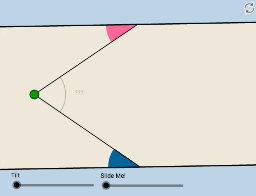
This example demonstrates the relationship between parallel lines and related angles, enhancing understanding of parallel line properties and angle bisector theorems through dynamic visualization. Core mathematical concepts include parallel line properties, corresponding angles, alternate interior angles, angle bisector theorem, and vector operations. Construction highlights involve GeoGebra commands/objects such as Rotate, Angle, Line, OrthogonalLine, Intersect, PointIn, Segment, Min, Circle, CircleSector, Dilate, Vector, Translate, and CircleArc. Suitable for high school mathematics students and teachers for learning and instructional demonstration, aiding comprehension of analytical geometry and geometric construction methods.
GeoGebra Commands & Parameters
Rotate(B, α, A) → B'Angle(B, A, B') → βLine(A, B') → fLine(C, f) → gOrthogonalLine(C, f) → hIntersect(f, h) → DPointIn(d) → ESegment(C, E) → iSegment(E, D) → jMin(i, j) → kCircle(C, (0.25 * k)) → pCircle(D, (0.25 * k)) → qIntersect(q, f) → F, GIntersect(q, j) → H,Intersect(p, g) → I, JIntersect(p, i) → K,CircleSector(C, I, K) → rCircleSector(D, H, F) → sDilate(C, If[0 < m ≤ 1, 1 - m, 0], E) → C'Vector(C, C') → uTranslate(r, u) → r'Rotate(r', If[1 < m ≤ 2, ((m - 1) * π), π], E) → r''Dilate(D, If[2 < m ≤ 3, 3 - m, 0], E) → D'Vector(D, D') → vTranslate(s, v) → s'Rotate(s', If[3 < m ≤ 4, ((m - 3) * π), π], E) → s''Circle(E, (0.25 * k)) → tIntersect(t, j) → M,Intersect(t, i) → N,CircleArc(E, M, N) → c_1
AI Drawing Prompt Reference
Draw two parallel lines AB and CD with their angle relationships. First, rotate point B around point A to get B', then calculate the angle β between B and B'. Next, draw line f through A and B', and draw line g through C and f. Then, construct the perpendicular line h to f, and find the intersection D of f and h. After that, find point E on line segment CE, draw line segments DE, and calculate the minimum length k. With C as the center and k/4 as the radius, draw circle p, and with D as the center and k/4 as the radius, draw circle q. Find their intersections with lines f and g to construct sectors r and s. Then, construct vector u from C to E, and scale C to C' with E as the center. Rotate and scale u to get r' and r''. Similarly, scale D to D' with E as the center, and rotate and scale v to get s' and s''. Finally, draw circle t with E as the center and k/4 as the radius, and find its intersections M and N with line segment DE to construct arc c_1.
The prompt above was compiled from the original drawing commands and is for reference only.