
Intersection of Lines Examples via Vectors
Loading the math board and drawing, please wait…
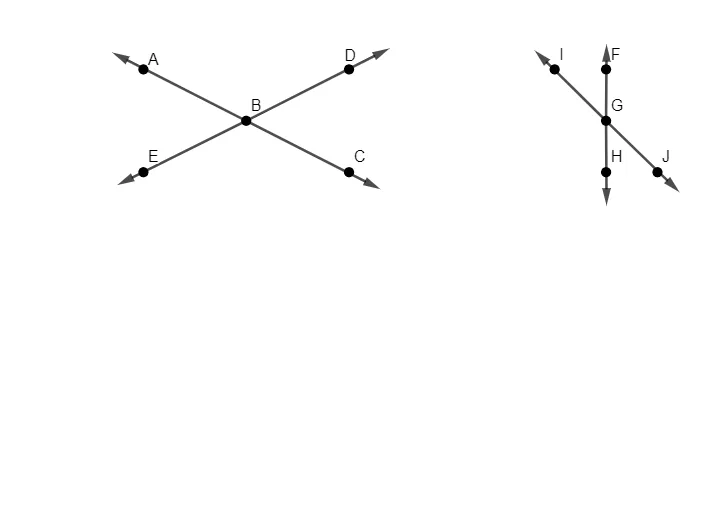
This example demonstrates how intersection points arise by constructing multiple lines in the plane and visualizing how their crossings are determined by underlying constraints. The key mathematical ideas include line intersections, vector-based representations (direction and position), and the way vector or coordinate relations can be used to locate intersection geometry. It is also designed to connect to related concepts such as angle/distance reasoning within common configurations like triangles or quadrilaterals, aligning with the example’s links to trigonometry and arithmetic-style computations. Construction-wise, the GeoGebra command shown in the construct summary is Vector, together with a collection of point and vector objects (A, B, C, D, E, F, G, H, I, J, K, u, L, v, M, w, N, a, O, b, P, c, Q, d, R, e). This indicates that the intersections are produced through vector variables and the geometric relationships derived from those objects. Suitable for middle school to early undergraduate learners, particularly for coordinate geometry and vector geometry instruction, as well as classroom demonstrations and self-study on the geometric meaning of solving for line intersections.
GeoGebra Commands & Parameters
Vector(B, K) → uVector(B, L) → vVector(B, M) → wVector(B, N) → aVector(G, O) → bVector(G, P) → cVector(G, Q) → dVector(G, R) → e
AI Drawing Prompt Reference
Draw two families of lines in the plane, each defined by a starting point and a direction vector. From one base point, extend several lines in different directions; from a second base point, extend several more lines in different directions. These lines intersect each other, creating multiple crossing points. Emphasize how the intersections are determined by the direction vectors and positions of the lines, illustrating the geometric meaning of solving for line intersections using vectors. Include common shapes like triangles or quadrilaterals to observe angle and distance relationships.
The prompt above was compiled from the original drawing commands and is for reference only.