
Lesson 17 Resolving Vectors on the Slope
Loading the math board and drawing, please wait…
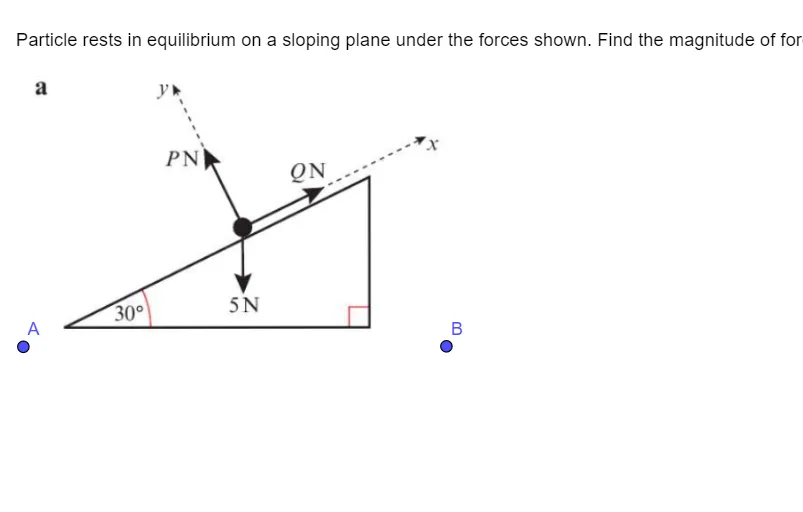
① This example demonstrates how to resolve a vector (such as force or displacement) into two perpendicular components along and perpendicular to an inclined plane, visually illustrating the geometric meaning of vector resolution. ② Core mathematical concepts include orthogonal decomposition of 2D vectors, trigonometric relationships in right triangles (sine and cosine), and vector projection onto tilted coordinate axes. ③ Construction highlights: using GeoGebra point objects A and B to define the endpoints of the slope, an image object pic1 to provide a slope background or schematic, and a text object text1 to label the resolved components and angle information; the construction is simple and adjustable. ④ Suitable for high school students (e.g., Year 12) learning vectors and trigonometry, as well as physics applications involving forces on inclined planes, helping learners grasp vector operations in a slope model.
GeoGebra Commands & Parameters
Point A(-4.454, -4.966)Point B(6.576666666666662, -4.953333333333333)
AI Drawing Prompt Reference
Draw a slope with endpoints at (-4.454, -4.966) and (6.577, -4.953). Decompose a vector on the slope into two perpendicular components along and perpendicular to the slope. Add a background image as a slope schematic and label the components and angle information on the diagram.
The prompt above was compiled from the original drawing commands and is for reference only.