
Sketch the Derivative (Warm Up)
Loading the math board and drawing, please wait…
In collections
Graphing derivatives
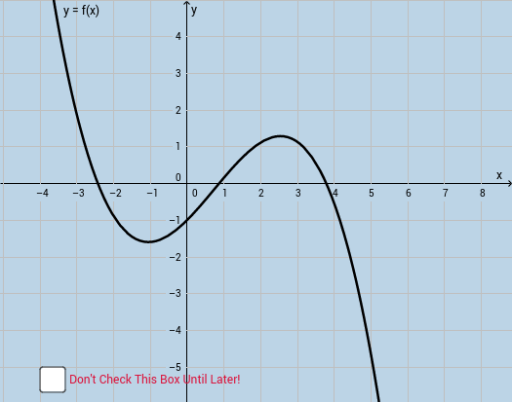
This interactive warm-up activity asks students to sketch the graph of the derivative of a given function f based on its visual appearance, with immediate feedback provided. The core mathematical concept is the geometric interpretation of the derivative: the value of the derivative at a point equals the slope of the tangent line to the original function at that point. Thus, intervals where f increases correspond to positive derivative values, intervals where f decreases correspond to negative values, and local extrema of f align with zeros of the derivative. The construction uses GeoGebra objects f (the original function), g (the derivative function), and a variable a likely used for feedback or dynamic adjustment. Students can draw or manipulate a curve, and the system checks its match with the true derivative graph. This resource is suitable for high school or introductory college calculus students, helping them build intuition about the relationship between a function and its derivative, and can be used as a classroom warm-up or self-assessment exercise.
GeoGebra Commands & Parameters
f(x) = (-1 / 8 * (x + 1.3923795272694095)^(3)) + (0.8 * (x + 1.3923795272694095)^(2)) - ((0.5 * (x + 1.3923795272694095)) + 1.5097050891378743)g(x) = f'(x)Boolean a(false)
AI Drawing Prompt Reference
Draw a coordinate plane for a derivative warm-up exercise. Include a cubic polynomial curve as the original function, which rises, falls, then rises again, with two local extrema. Also plot its derivative, a quadratic parabola, whose zeros align with the x-coordinates of the original function's extrema. The derivative is positive where the original increases and negative where it decreases. Use distinct colors for the two curves and add grid lines to help observe slope changes. The graph should clearly show the geometric relationship between the function and its derivative, allowing students to sketch the derivative's shape by visual inspection.
The prompt above was compiled from the original drawing commands and is for reference only.