
Sine and Cosine Segment Trace
Loading the math board and drawing, please wait…
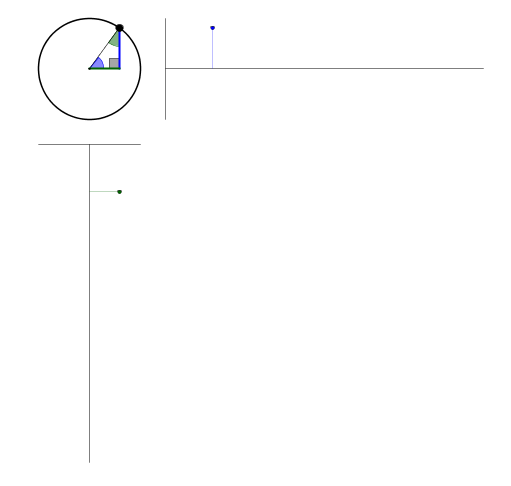
This example demonstrates the application of sine and cosine functions in geometry. It involves core concepts of trigonometry, using commands such as Circle, Point, Segment, Line, Intersect, OrthogonalLine, and Angle in GeoGebra to show how sine and cosine values change with the angle. Suitable for high school mathematics education, helping students understand the geometric meaning of trigonometric functions.
GeoGebra Commands & Parameters
Circle(A, 1) → cPoint(c) → BSegment(C, D) → fSegment(E, F) → gLine(A, I) → hLine(A, G) → iIntersect(i, f) → KIntersect(h, g) → LOrthogonalLine(B, i) → jSegment(A, B) → kIntersect(i, j) → MAngle(K, A, B) → βSegment(M, B) → lSegment(A, M) → mPoint(Circle[K, (2 * π)]) → PSegment(K, P) → nPoint(Circle[L, (2 * π)]) → QSegment(L, Q) → pSegment(N, R) → qSegment(O, S) → rAngle(M, A, B) → αAngle(A, M, B) → γAngle(M, B, A) → δ