
Interactive Quadrilaterals
Loading the math board and drawing, please wait…
In collections
Elementary Geometry
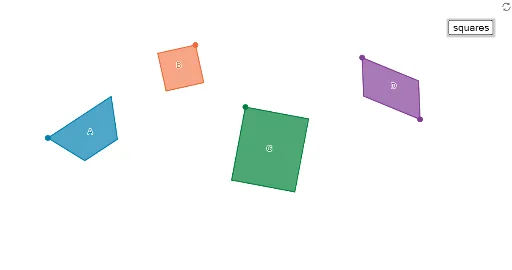
This example demonstrates the interactive properties of quadrilaterals. Key mathematical concepts include the properties of quadrilaterals, angles, and transformations. Using GeoGebra commands such as Point, Segment, Rotate, and Polygon, users can dynamically explore various changes in quadrilaterals. Suitable for junior high school geometry education.
GeoGebra Commands & Parameters
Point(Circle[M, 5]) → NSegment(M, N) → i_1OrthogonalLine(M, i_1) → j_1Point(j_1) → SPoint(j_1) → RSegment(R, S) → r_1Circle(A, 2) → cTranslate(c, (-3, 3)) → c'PointIn(c') → controlASegment(A, B) → fLine(controlA, f) → gRotate(A, (-Angle[B, A, controlA]), B) → A'Angle(A, B, A') → αRay(B, A') → hIntersect(h, g) → DPolygon(A, B, D, controlA) → Qisotrap, i, j, k, lPoint(Circle[I, 3]) → controlBSegment(I, controlB) → rPolygon(I, controlB, 4) → Qsquare, s, t, a, b, K, LPoint(Circle[E, 3.5]) → FSegment(E, F) → mCircle(E, 3.5) → dPoint(d) → GLine(G, m) → nSegment(E, G) → pLine(F, p) → qIntersect(n, q) → HPolygon(E, G, H, F) → Qpgram, e, g_1, h_1, f_1Circle(M, i_1) → c_1Intersect(c_1, j_1, 2) → squareCOrthogonalLine(N, i_1) → k_1Point(r_1) → controlCOrthogonalLine(controlC, k_1) → l_1PointIn(rangeForD) → controlD0Intersect(k_1, l_1) → QPolygon(M, controlC, Q, N) → quadRect, m_1, p_1, q_1, n_1Segment(T, controlD0) → s_1Point(Circle[T, 3]) → controlDSegment(T, controlD) → t_1Line(controlD, s_1) → a_1Line(controlD0, t_1) → b_1Intersect(a_1, b_1) → WPolygon(T, controlD, W, controlD0) → quadParallelogram, t_2, v, w, uPolygon(Z, A_1, 4) → poly1, d_1, e_1, f_2, g_2, B_1, C_1Ray(Z, B_1) → h_2Point(h_2) → D_1Point(h_2) → E_1Segment(D_1, E_1) → i_2Point(i_2) → F_1Polygon(Z, C_1, F_1, A_1) → q3, z_1, j_2, k_2, l_2Polygon(Z, C_1, A_1) → t1, m_2, z_2, n_2IsInRegion(F_1, t1) → isDartPolygon(Z, C_1, F_1, A_1) → q4, z_3, p_2, q_2, r_2Point(Circle[G_1, 4]) → H_1Segment(G_1, H_1) → s_2Translate(Circle[G_1, 3], (3, 4)) → c_2PointIn(c_2) → I_1Polygon(G_1, H_1, I_1, J_1) → q5, a_2, b_2, d_2, e_2Intersect(Circle[T, 3], Ray[T, controlD0]) → resetD0,