
Simultaneous Equations as Vector Sums
Loading the math board and drawing, please wait…
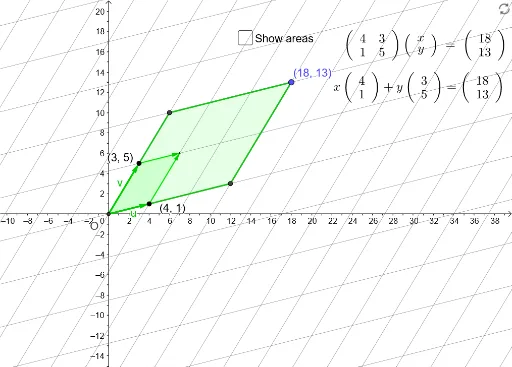
This GeoGebra example demonstrates how simultaneous linear equations can be visualized as vector sums. It represents each equation as a vector in the plane and uses the parallelogram law to show that the solution corresponds to the vector sum equaling a target vector. Core mathematical concepts include vector addition, systems of linear equations, parametric representation, and the geometric-algebraic connection. Construction highlights: uses commands such as Intersect, Vector, Line, Segment, Sequence, Translate, Polygon, and PointIn; key objects include points O, A, B, P, vectors u and v, lines a and b, and various auxiliary points and segments. Suitable for high school or early college students learning about linear systems and vector geometry, this example helps bridge algebraic solving with geometric intuition.
GeoGebra Commands & Parameters
Intersect(xAxis, yAxis) → OVector(A) → uVector(B) → vLine(O, A) → aLine(O, B) → bLine(A, b) → dLine(P, A_1) → mLine(P, B_1) → nIntersect(a, n) → CIntersect(b, m) → DSegment(O, D) → pSegment(O, C) → qSegment(P, D) → rSegment(P, C) → sSequence(Segment[((x(v) * a) + (x(u) * 20), (y(v) * a) + (y(u) * 20)), ((x(v) * a) + (x(u) * (-20)), (y(v) * a) + (y(u) * (-20)))], a, -20, 20) → seznam1Sequence(Segment[((x(v) * 20) + (x(u) * a), (y(v) * 20) + (y(u) * a)), ((x(v) * (-20)) + (x(u) * a), (y(v) * (-20)) + (y(u) * a))], a, -20, 20) → seznam2Translate(A, v) → A'Vector(A, A') → zTranslate(B, u) → B'Vector(B, B') → gPolygon(O, A, A', B) → q2, o_2, a_6, a', b_1Polygon(O, C, P, D) → q1, o, c, p_1, d_1Intersect(f, h) → EPointIn(q1) → Pointq1PointIn(q2) → Pointq2