
Shearer Action 4! Geometric Construction and Symmetry
Loading the math board and drawing, please wait…
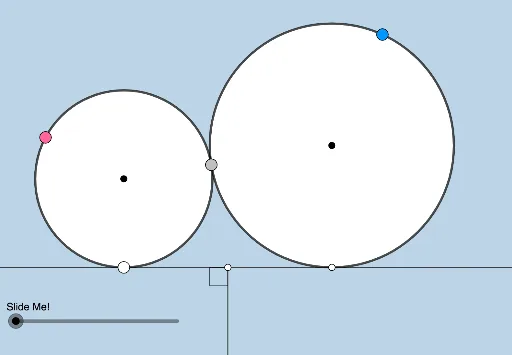
This example demonstrates solving geometric problems using dynamic tools. Key mathematical concepts include circles, vectors, centroid or barycenter, and Pythagorean theorem. Construction involves GeoGebra commands like Ray, Point, Circle, and OrthogonalLine. Suitable for middle school geometry learners to understand transformations and symmetry.
GeoGebra Commands & Parameters
Ray(A, A + (0, 1)) → fPoint(f) → BCircle(B, A) → cRay(A, A + (2, 0)) → hPoint(h) → CPoint(c) → FSegment(B, F) → jOrthogonalLine(F, j) → lLine(B, F) → mIntersect(g, l) → GAngle(C, G, F) → αRotate(C, α / 2, G) → C'Ray(G, C') → nIntersect(m, n) → HCircle(H, F) → dIntersect(d, g, 1) → DCircleArc(B, F, A) → eCircleArc(H, D, F) → kPoint(e) → EPoint(k) → IAngle(A, E, F) → βAngle(F, I, D) → γMidpoint(A, D) → JRay(J, J - (0, 1)) → iPoint(i) → KAngle(A, J, K) → εPoint(g) → LPoint(g) → MAngle(M, D, H) → ζAngle(B, A, L) → ηSegment(H, D) → qSegment(B, A) → pDilate(B, If[0 < b ≤ 1, 1 - b, 0], A) → B'Dilate(H, If[0 < b ≤ 1, 1 - b, 0], D) → H'Segment(B, B') → rSegment(H, H') → sDilate(E, If[1 < b ≤ 2, 2 - b, 0], A) → E'Dilate(E, If[1 < b ≤ 2, 2 - b, 0], F) → E'_1Dilate(I, If[1 < b ≤ 2, 2 - b, 0], F) → I'Dilate(I, If[1 < b ≤ 2, 2 - b, 0], D) → I'_1Segment(E, E') → tSegment(E, E'_1) → f_1Segment(I, I') → g_1Segment(I, I'_1) → h_1Min({Distance[E, A], Distance[E, F], Distance[I, F], Distance[I, D]}) → oCircle(E, (0.3 * o)) → c_1Circle(I, (0.3 * o)) → d_1Intersect(c_1, t, 1) → NIntersect(d_1, g_1, 1) → ORotate(O, If[2 < b ≤ 3, ((b - 2) * γ), γ], I) → O'Rotate(N, If[2 < b ≤ 3, ((b - 2) * β), β], E) → N'CircleSector(E, N, N') → e_1CircleSector(I, O, O') → k_1Line(E, i) → i_1Point(i_1) → PAngle(P, E, A) → θSemicircle(E, J) → p_1Rotate(E, If[4 < b ≤ 5, ((-(b - 4)) * π), (-π)], Midpoint[E, J]) → E'_2Vector(E, E'_2) → uTranslate(e_1, u) → q_1Rotate(q_1, If[4 < b ≤ 5, ((b - 4) * ((2 * π) - θ)), (2 * π) - θ], E'_2) → r_1Semicircle(J, I) → s_1Dilate(I, If[5 < b ≤ 6, 6 - b, 0], J) → I'_2Vector(I, I'_2) → vTranslate(k_1, v) → t_1Line(I, g) → j_1Point(j_1) → QAngle(D, I, Q) → κRotate(t_1, If[5 < b ≤ 6, ((-(b - 5)) * ((2 * π) - κ)), κ - (2 * π)], I'_2) → c_2