
Second Order Differential Equations for Damped Oscillations
Loading the math board and drawing, please wait…
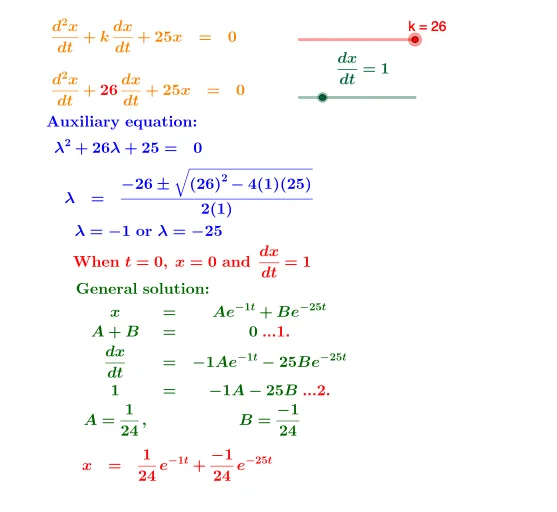
This example demonstrates damped oscillations using second-order differential equations. Key mathematical concepts include second-order differential equations and oscillation phenomena. GeoGebra commands such as Root, Intersect, and FractionText are used to construct the damped oscillation graph. Suitable for high school and above students studying calculus and oscillation theory.
GeoGebra Commands & Parameters
Root(f) → A_1, B_1Intersect(eq1, eq2) → CFractionText(A) → text7FractionText(B) → text8FractionText(p) → text20
AI Drawing Prompt Reference
Draw a damped oscillation graph with time on the horizontal axis and displacement on the vertical axis. Start with a decaying sine wave whose amplitude decreases over time. Mark two intersection points where the curve crosses the horizontal axis. Then add a horizontal line and a slanted line, and mark their intersection point. Include three fraction-style text labels near the graph: one for a coordinate value, one for another coordinate, and one for a parameter value. The overall image shows a typical damped oscillation with curve, intersection points, and fractional annotations.
The prompt above was compiled from the original drawing commands and is for reference only.