
Scaffolded Rectangle Template: Geometric Construction and Rotation
Loading the math board and drawing, please wait…
In collections
Congruence (CO) Cluster
Congruence (Vol 2)
CCSS High School: Geometry (Congruence) Volume 2
CCSS High School: Geometry (Congruence) Volume 2
CCSS High School: Geometry (Congruence) Volume 2
Geometry (Congruence) Volume 2
CCSS High School: Geometry (Congruence) Volume 2
CCSS High School: Geometry (Congruence) Volume 2
CCSS High School: Geometry (Congruence) Volume 2
CCSS High School: Geometry (Congruence) Volume 2
CCSS High School: Geometry (Congruence) Volume 2
CCSS High School: Geometry (Congruence) Volume 2
Gail LeBlancCCSS High School: Geometry (Congruence) Volume 2
CCSS High School: Geometry (Congruence) Volume 2
CCSS High School: Geometry (Congruence) Volume 2
Unit 7: Polygons and Quadrilaterals
Quadrilaterals
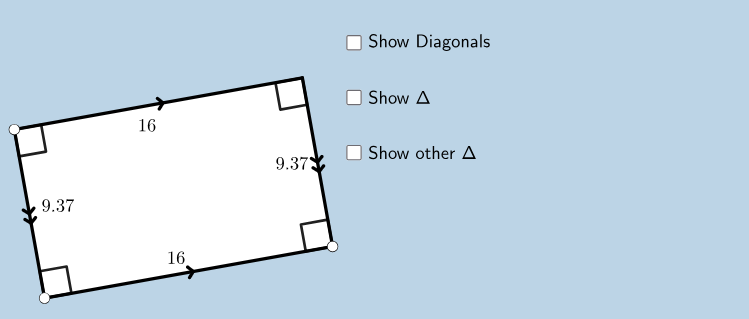
This example presents a scaffolded rectangle template built with a network of auxiliary lines, perpendiculars, points, intersections, and midpoints, forming a dynamic rectangular framework that supports rotation and mirror transformations. The core mathematical concepts include properties of rectangles, relationships between segments and angles, symmetry transformations, and the application of trigonometric functions in rotation. The construction utilizes GeoGebra commands such as Segment, OrthogonalLine, Point, Intersect, Angle, Midpoint, Polygon, Line, and Mirror, creating a complex system of objects labeled A, B, a, b, c, α, β, γ, etc. This template is suitable for middle and high school geometry instruction, enabling exploration of rectangle properties, rotational transformations, and the integration of function graphs with geometric construction. It serves as a dynamic demonstration tool to help students understand dependencies among geometric objects and transformation rules.
GeoGebra Commands & Parameters
Segment(A, B) → aOrthogonalLine(A, a) → bOrthogonalLine(B, a) → cPoint(b) → DOrthogonalLine(D, b) → dIntersect(c, d) → CSegment(D, A) → eSegment(D, C) → fSegment(C, B) → gAngle(C, B, A) → αAngle(B, A, D) → βAngle(A, D, C) → γAngle(D, C, B) → δMidpoint(D, B) → MSegment(D, M) → hSegment(M, B) → iSegment(A, M) → jSegment(M, C) → kAngle(B, A, M) → εAngle(M, B, A) → ζAngle(D, C, M) → ηAngle(M, D, C) → θAngle(A, D, M) → ιAngle(M, A, D) → κAngle(C, B, M) → λAngle(M, C, B) → μPolygon(A, B, C) → poly1, c_1, a_1, b_1Line(A, C) → nMirror(A, n) → A'Mirror(B, n) → B'Mirror(C, n) → C'Polygon(A', B', C') → poly_2, c', a', b'Polygon(D, A, B) → poly2, b_2, d_1, a_2Mirror(D, a_2) → D'Mirror(A, a_2) → A'_1Mirror(B, a_2) → B'_1Polygon(D', A'_1, B'_1) → poly2', b'_1, d', a'_1Polygon(A, B, C, D) → poly3, a_3, b_3, c_2, d_2Segment(A, C) → qSegment(D, B) → t