
Sample Size Variation Examples
Loading the math board and drawing, please wait…
In collections
Sample Size
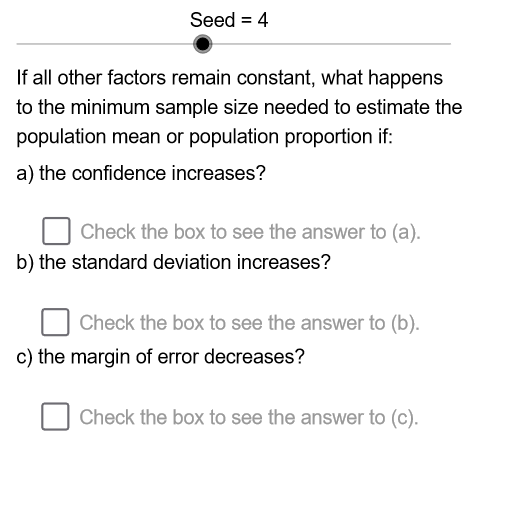
This example demonstrates how the sample size needed to estimate population mean or proportion changes, covering core concepts in probability & statistics. It is constructed using GeoGebra commands like If, Sequence, and objects such as Seed, PrbStmt, Question, A, B, C, MixedSeq, Ainc, Adec, PartA, Inc, Dec, AnsA, Binc, Bdec, a, b, Cinc, Cdec, PartC, AnsC, c, PartB, AnsB, QALoc, QBLoc, QCLoc for dynamic problem generation and solutions, suitable for high school students and educators.
GeoGebra Commands & Parameters
If(Seed ≟ 1, 7, If[Seed ≟ 2, 6, If[Seed ≟ 3, 1, If[Seed ≟ 4, 4, If[Seed ≟ 5, 3, If[Seed ≟ 6, 2, If[Seed ≟ 7, 8, 5]]]]]]) → QuestionIf(Mod[Question - 1, 2] ≟ 0, 0, 1) → AIf(Mod[Question - 1, 4] > 1, 1, 0) → BIf(Question - 1 > 3, 1, 0) → CSequence(Mod[(3 * k), 8], k, 0, 7) → MixedSeqIf(A ≟ 1, Ainc, Adec) → PartAIf(A ≟ 1, Inc, Dec) → AnsAIf(C ≟ 1, Cinc, Cdec) → PartCIf(C ≟ 1, Dec, Inc) → AnsCIf(B ≟ 1, Binc, Bdec) → PartBIf(B ≟ 1, Inc, Dec) → AnsB
AI Drawing Prompt Reference
Create a sample size variation example to demonstrate how the required sample size for estimating population mean or proportion changes. Use a random number generator based on different seed values to dynamically generate questions, answers, and partial answers. First, generate a random number between 7 and 8 as the question, then determine variables A, B, and C based on the question's parity and value to control the increase or decrease of answers for A, B, and C.
The prompt above was compiled from the original drawing commands and is for reference only.