
Same-Side Interior Angles: Thin Slice Task 4
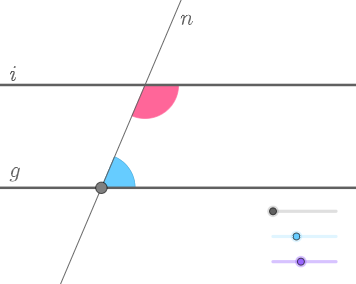
Loading the math board and drawing, please wait…
In collections
Parallel Lines and Related Angles: Guided Exploration
This GeoGebra example demonstrates the geometric relationship between same-side interior angles formed when two lines are cut by a transversal. By constructing and tracking angle measures (e.g., α, β, γ, δ), it highlights how corresponding interior angles on the same side relate under the configured line positions. Key concepts include interior angles, same-side angle properties, and the angle-chasing logic often tied to parallel-line reasoning. The construction uses GeoGebra commands such as Point and Line to define the baseline geometry; Ray and Segment to build the relevant angle arms; Rotate and Translate to create the “thin slice” positional change; Angle to label and measure the interior angles; Circle, CircleSector, and CircleArc to create arc-based visual supports; Intersect to anchor key points where constraints meet; and Vector to maintain consistent directional structure. Suitable for secondary-school geometry (parallel lines and angles) and dynamic-geometry learning activities.
GeoGebra Commands & Parameters
Point(y = 0) → ALine(A, B) → fRotate(B, α, A) → B'Angle(B, A, B') → γLine(A, B') → gRotate(B', β, A) → B''Angle(B', A, B'') → δLine(A, B'') → hCircle(A, a) → cIntersect(c, h, 2) → CLine(C, g) → iCircle(C, A) → dCircle(A, C) → eIntersect(e, h, 2) → JSegment(A, C) → jCircle(A, (0.3 * j)) → kCircle(C, (0.3 * j)) → pIntersect(p, h) → N, OIntersect(k, h) → P, QIntersect(k, g) → T, UIntersect(p, i, 2) → VIntersect(p, i, 1) → WCircleSector(A, U, Q) → qCircle(C, j / 2) → g_1Circle(A, j / 2) → h_1Intersect(g_1, i, 2) → DIntersect(g_1, i, 1) → EIntersect(g_1, h, 2) → HIntersect(g_1, h) → I, ZIntersect(h_1, h) → A_1, B_1Intersect(h_1, g) → E_1, F_1Point(j) → G_1Vector(A, G_1) → uTranslate(q, u) → q'Segment(A, G_1) → lRay(A, A_1) → mRay(C, H) → nVector(A, G_1) → vSegment(G_1, C) → sCircleArc(A, U, Q) → tCircleArc(C, N, O) → rPoint(r) → FRotate(F, (-δ), C) → F'Angle(F', C, F) → εSegment(A, C) → bCircleSector(C, N, V) → d_1
AI Drawing Prompt Reference
Draw a geometric diagram illustrating same-side interior angles. Start with a horizontal baseline and create three rays emanating from a common point on the left, formed through successive rotations to create two distinct angles. Where these rays intersect another slanted line, mark each corresponding angle with circular arcs. Include multiple concentric arc layers to highlight the angle regions, along with a set of parallel line segments indicating angle translation relationships. The entire figure uses dynamic rotation and angle marking to demonstrate how same-side interior angles are positioned when a transversal cuts two lines.
The prompt above was compiled from the original drawing commands and is for reference only.