
Rotational symmetry and lines of symmetry of a regular polygon
Loading the math board and drawing, please wait…
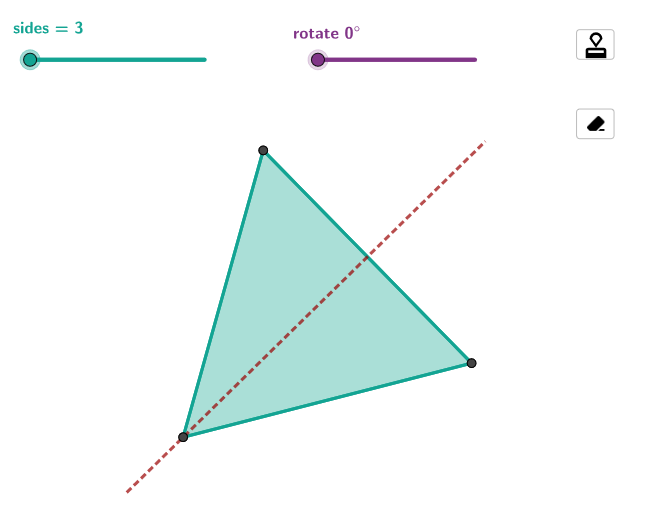
This example demonstrates the rotational symmetry and lines of symmetry of regular polygons. Key mathematical concepts include symmetry, rotation, and geometric construction. Construction involves GeoGebra commands such as Intersect, Point, Polygon, Rotate, etc. Suitable for middle or high school mathematics teaching to understand geometric symmetry.
GeoGebra Commands & Parameters
Intersect(xAxis, yAxis) → APoint(yAxis) → BCircle(A, B) → cPoint(c) → CSequence(Rotate[C, ((i * 2) * pi / n), A], i, 1, n) → vertPolygon(vert) → poly1Rotate(C, rot, A) → C'Line(C', A) → fMirror(poly1, f) → poly1'Vertex(poly1) → D, E, F, G, H, D_{1}, D_{2}, D_{3}Vertex(poly1') → I, J, K, L, M, N, P, QPoint(f) → OCircle(A, O) → dMirror(O, A) → O'Segment(O', O) → gCenter(c) → CT
AI Drawing Prompt Reference
Draw a regular polygon and demonstrate its rotational symmetry and lines of symmetry. Start by plotting the intersection of the coordinate axes and creating a circle. Generate the vertices of the polygon based on points on the circle. Then, rotate one vertex around the circle's center to form a line of symmetry. Mirror the polygon across this line to create a symmetrical counterpart. Finally, draw a circle that includes all vertices and connect the circle's center to the intersection point with the line of symmetry to complete the illustration.
The prompt above was compiled from the original drawing commands and is for reference only.